What is TECHINT?
The Intelligence Fundamentals Project

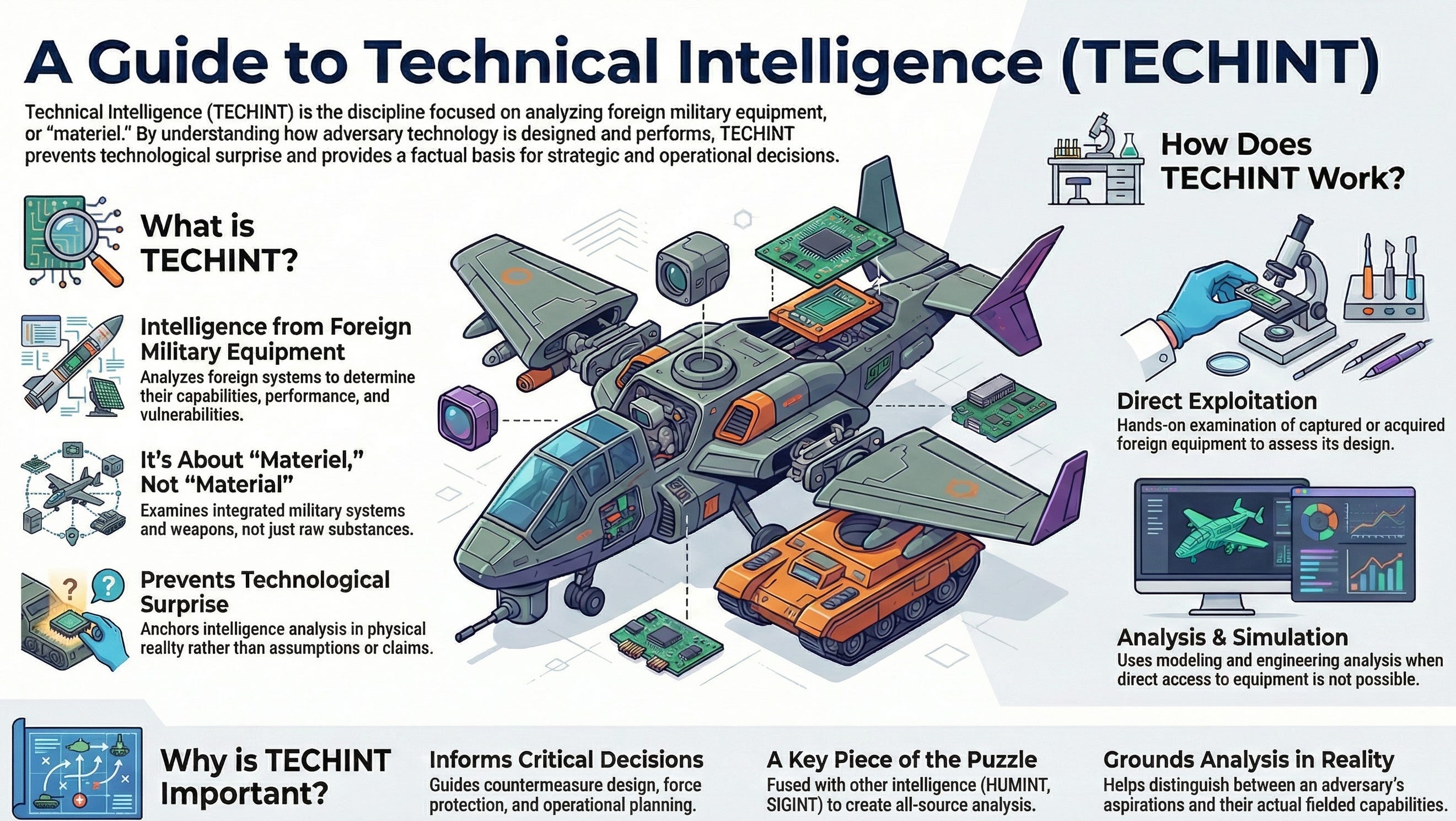
Technical Intelligence, or TECHINT, exists to answer a specific kind of question inside the intelligence enterprise: what foreign military systems can actually do once they are built, fielded, and stressed in the real world.
Doctrine defines TECHINT as intelligence derived from the exploitation and analysis of foreign materiel and associated technical data to determine performance, capabilities, vulnerabilities, and technological characteristics (JP 2-0 2022; FM 2-0 2023). That definition matters less for its phrasing than for what it implies. TECHINT is grounded in how systems are designed and engineered, not how they are described, advertised, or intended to be used.
Inside the enterprise, TECHINT focuses on foreign materiel. That includes weapons systems, platforms, components, and enabling technologies. The analytic task is to understand how these systems function as built systems, how they perform under realistic conditions, and where their limits show up. Those answers feed operational planning, countermeasure development, force protection, and long-term capability decisions. They do not replace other intelligence disciplines. They fill a gap that observation, reporting, and inference cannot close on their own.
Why Doctrine Uses “Materiel” and Not “Material”
Doctrine is precise when it uses the term materiel, and that precision reflects how the discipline works. This annoyed me significantly until I understood it carried a clear meaning (something I didn’t learn until a stint with DTRA!)
Materiel refers to military equipment, weapons, systems, and associated components that are fielded, tested, sustained, or exploited. It is an operational term used across Department of Defense doctrine to describe tangible items with military function and capability. When doctrine refers to foreign materiel exploitation, it is talking about captured or acquired systems, platforms, components, and equipment that can be examined to determine performance, vulnerabilities, and design characteristics.
Material, by contrast, is a general term for physical substances. It might describe metals, composites, or chemical compounds in a scientific or industrial sense, but it does not carry the operational meaning required for intelligence analysis. TECHINT is not about substances in isolation. It is about how those substances are integrated into functioning systems that must survive stress, production constraints, and operational use.
Using materiel signals that the analysis is focused on integrated military capability rather than abstract properties. That distinction shapes how questions are framed and how conclusions are drawn.
What TECHINT Is Trying to Prevent
At its core, TECHINT exists to reduce uncertainty about adversary capabilities and to prevent technological surprise (FM 2-0 2023). It does this by anchoring analysis in physical reality. Claims, intent, and doctrine all matter, but they remain incomplete without understanding what the technology itself allows or constrains.
TECHINT narrows the range of plausible outcomes. It tells analysts and decision-makers where systems are likely to perform as advertised, where they will struggle, and where assumptions break down once engineering tradeoffs and production realities are accounted for.
What TECHINT Actually Does
TECHINT analyzes foreign equipment and materiel to determine design characteristics, performance parameters, vulnerabilities, and potential countermeasures (JP 2-0 2022). This includes weapons systems, sensors, vehicles, materials used within systems, and enabling technologies across land, air, maritime, space, and related domains.
A central activity within TECHINT is foreign materiel exploitation. When access exists, analysts examine captured, recovered, or otherwise obtained foreign equipment and components to understand system design, materials selection, manufacturing quality, and performance limits (FM 2-0 2023). Exploitation moves analysis past external indicators and into component-level and subsystem-level behavior, where many critical limitations reveal themselves.
When direct exploitation is not possible, TECHINT relies on modeling, simulation, engineering analysis, and structured comparison with known systems to estimate performance and behavior (JP 2-0 2022). These methods are used to test how systems might operate under realistic conditions and how they could evolve over time. The goal is not cataloging hardware. It is understanding capability, limitations, and developmental trajectory well enough to support decisions.
Why TECHINT Remains Relevant
TECHINT plays a central role in preventing technological surprise by clarifying what adversary systems can realistically achieve and where their constraints lie (FM 2-0 2023). It helps decision-makers avoid inflating threats based on propaganda or novelty, and it reduces the risk of dismissing capabilities simply because they follow unfamiliar design approaches.
TECHINT informs weapons development, countermeasure design, force protection, and operational planning (JP 2-0 2022; FM 2-0 2023). Its value spans immediate operational decisions and long-term strategic planning by clarifying what adversaries can field, sustain, and incrementally improve.
TECHINT does not assess intent or strategy on its own. It supplies the technical boundaries within which those assessments must operate. When integrated with other intelligence disciplines, TECHINT keeps analytic judgments tied to what is physically and technologically plausible.
How TECHINT Functions Inside All-Source Analysis
TECHINT is rarely consumed in isolation. Its value emerges when it is fused with HUMINT, SIGINT, GEOINT, MASINT, CI, and OSINT as part of all-source analysis (JP 2-0 2022).
HUMINT may indicate development priorities or acquisition intent. SIGINT may reveal testing activity or system employment. GEOINT may show production facilities, deployment patterns, or supporting infrastructure. MASINT may characterize performance signatures. TECHINT connects these inputs by explaining how the underlying technology works and what that functionality enables or restricts.
Within all-source analysis, TECHINT constrains assumptions, validates claims, and sharpens analytic judgments. It helps analysts separate aspiration from fielded capability and distinguish deception from genuine technological progress (FM 2-0 2023).
How OSINT Supports TECHINT
OSINT supports TECHINT by providing context, background, and early indicators related to foreign technology development.
Open sources can reveal research directions, industrial capacity, supply chains, standards development, and international partnerships (JP 2-0 2022; FM 2-0 2023). Academic publications, patents, procurement data, trade reporting, and industry disclosures often provide early insight into technology maturity and development pathways before systems appear in operational form.
OSINT also supports comparative analysis by offering reference points from commercial and dual-use technologies. Many military systems draw directly from civilian research and industry. Open sources help analysts judge what is plausible given known engineering constraints and production realities (SACLANT 2002).
Within all-source analysis, OSINT helps TECHINT findings connect to broader operational and strategic context. It fills gaps, tests assumptions, and informs prioritization without substituting for technical exploitation.
Closing
TECHINT does not replace other intelligence disciplines. It does not explain decision-making, intent, or operational context on its own. Its contribution lies in technical precision and constraint, not narrative completeness.
TECHINT assessments are bounded by access to materiel, data quality, and analytic assumptions (JP 2-0 2022). Like all intelligence disciplines, TECHINT depends on corroboration and integration to support reliable analytic judgment.