What is SIGINT?
The Intelligence Fundamentals Project

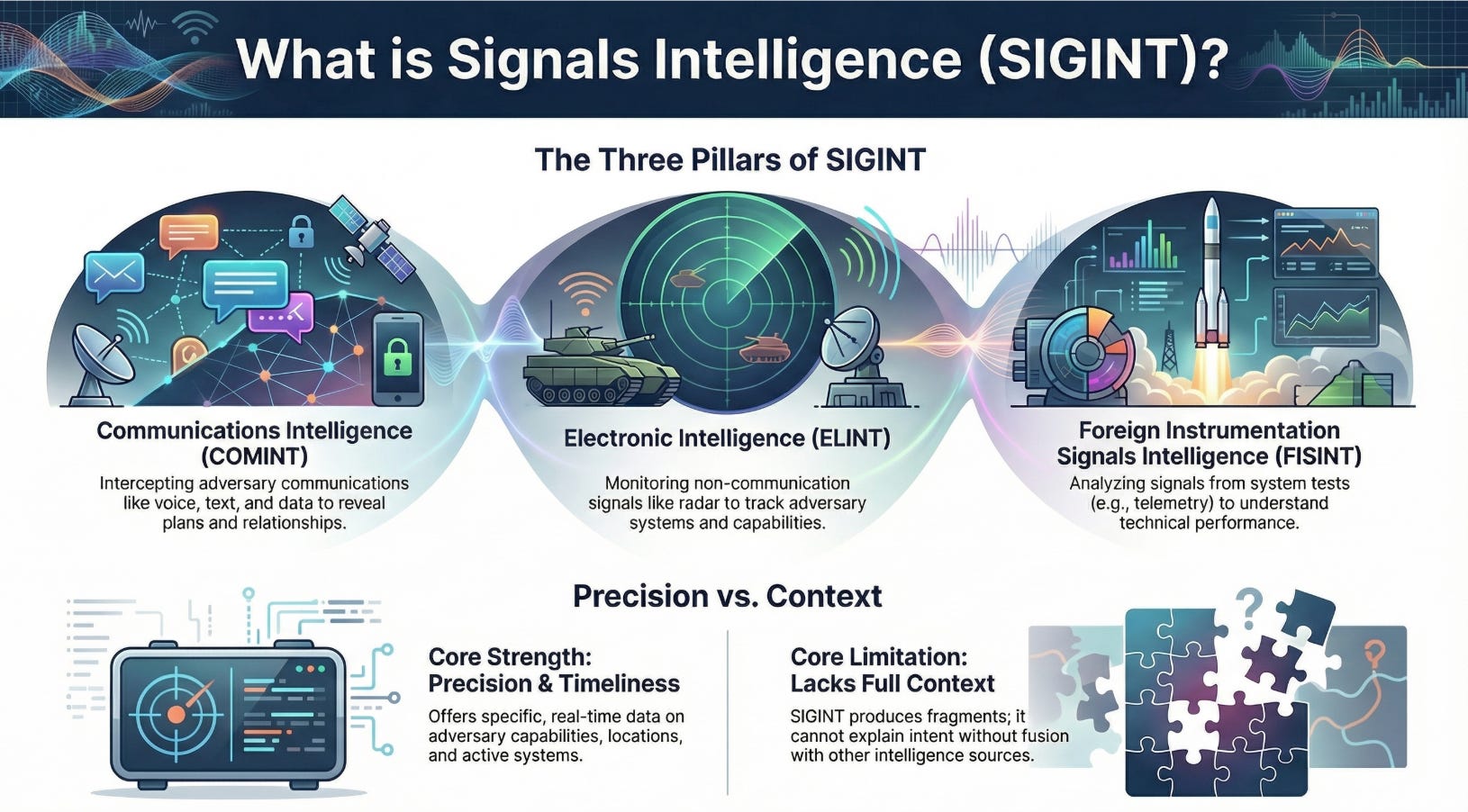
Signals Intelligence derives insight from communications and emissions across the electromagnetic spectrum, providing time-sensitive and technically precise access to adversary activity.
Doctrine defines SIGINT as intelligence derived from communications, electronic, and foreign instrumentation signals (JP 2-0 2022). Through those signals, SIGINT provides access to what adversaries are communicating, what their systems are emitting, and how platforms operate within the electromagnetic environment. That access is often immediate and highly technical, which gives SIGINT its distinctive value inside the enterprise.
That same precision also creates limits. In isolation, SIGINT frequently produces fragments: intercepts, technical indicators, emissions data, or short-lived observations tied to a specific moment or system. Those fragments do not automatically explain intent, consequence, or broader meaning. Analytic value emerges when SIGINT reporting is integrated with OSINT, HUMINT, GEOINT, and other intelligence sources. Fusion provides context, constrains overinterpretation, and allows analysts to move from signal-level detail to defensible judgment.
SIGINT is best understood as one discipline within a broader enterprise. It offers a particular kind of access, not a standalone answer. It can tell you what is transmitting, what is active, and what is changing, but it typically cannot explain motivation, consequence, or full operational context without support from other intelligence streams.
The Three Pillars of SIGINT
Doctrinally, SIGINT is composed of three subcategories, each focused on a different signal environment:
Communications Intelligence (COMINT)
Communications Intelligence is intelligence derived from intercepting and monitoring an adversary’s communications systems (AFDP 2-0 2025). This includes voice, text, data transmissions, and other forms of communicated information.
COMINT can reveal patterns of behavior, command relationships, coordination, and in some cases indications of intent. It may provide early signs of planning or preparation. Communications alone rarely explain the full situation. Without context, analysts risk mistaking routine traffic for meaningful change or over-weighting isolated intercepts.
Electronic Intelligence (ELINT)
Electronic Intelligence is intelligence derived from intercepting noncommunications electromagnetic emitters, such as radars and weapon system sensors (AFDP 2-0 2025). ELINT includes operational and technical electronic intelligence and helps analysts understand where systems are located, how they move, how they are employed, and how they behave under different conditions.
ELINT supports assessments of threat capabilities, system performance, and potential vulnerabilities (AFDP 2-0 2025). It is especially useful for tracking posture shifts, identifying activation patterns, and supporting warning and targeting.
Foreign Instrumentation Signals Intelligence (FISINT)
Foreign Instrumentation Signals Intelligence provides technical intelligence derived from electromagnetic emissions associated with the testing and deployment of foreign air, space, surface, and subsurface systems (AFDP 2-0 2025). These signals include telemetry, electronic interrogators, and video data links.
FISINT can provide detailed insight into system performance, limitations, and design characteristics. Its value is typically technical and often requires fusion with other reporting to support broader analytic judgments, especially when translating testing behavior into operational implications.
Why SIGINT Is Relevant
SIGINT provides information on adversary forces’ capabilities, intentions, formations, and locations and supports strategy, policy, military planning, and operations from national to tactical levels (AFDP 2-0 2025). Its strength lies in precision and timeliness, offering insight into what systems are active, how they are being used, and how conditions may be changing.
Analytically, SIGINT contributes direction finding and geolocation that support pattern analysis and situational awareness (AFDP 2-0 2025). COMINT can expose coordination, dependencies, and vulnerabilities within adversary networks (AFDP 2-0 2025). Across its subdisciplines, SIGINT adds technical detail that helps analysts assess what is possible, what is occurring, and what constraints exist.
SIGINT also plays a role in threat warning and targeting. It contributes to electronic warfare support for warning, cues other sensors, and supports cross-cueing for collection, reconnaissance, and further analysis (JP 2-0 2022; AFDP 2-0 2025). These contributions strengthen analysis when SIGINT is deliberately integrated with other intelligence inputs. Without contextual grounding, SIGINT reporting can be precise while remaining incomplete.
Constraints and Oversight
SIGINT is tightly governed because of its sensitivity and technical complexity. The National Security Agency retains control over strategic-capable SIGINT Intelligence, Surveillance, and Reconnaissance (ISR) systems (AFDP 2-0 2025). Title 50 governs SIGINT production in support of national strategy and operations, while Title 10 governs the authority for SIGINT teams to conduct analysis on threat signals to produce intelligence (JP 2-0 2022).
These legal and organizational boundaries shape how SIGINT is tasked, collected, analyzed, and disseminated across the enterprise. They reinforce that SIGINT is not an ad hoc capability and that its use must align with national authorities, oversight mechanisms, and enterprise-level coordination.
How OSINT Supports SIGINT
OSINT plays a direct supporting role for SIGINT by providing context, supporting interpretation, and filling analytic gaps. Open-source information helps analysts understand the political, social, economic, and operational environment in which signals are collected and evaluated (SACLANT 2002).
OSINT can serve as a tip-off for classified collection and help analysts distinguish between routine background activity and signals that merit closer attention (SACLANT 2002). It also supports warnings, tips, and cues across intelligence disciplines and fills gaps where classified databases are limited or delayed (JP 2-0 2022).
All-source analysis compares and evaluates classified and open-source material together (JP 2-0 2022). Within that process, OSINT helps ground SIGINT reporting in observable reality, reducing misinterpretation and strengthening analytic confidence.
SIGINT provides access to signals. OSINT provides context for meaning. Neither discipline replaces the other, and both are more effective when deliberately integrated.
Closing
SIGINT provides technically precise, time-sensitive insight into communications and emissions across the electromagnetic spectrum. Its reporting is often narrow by design, focused on specific signals, systems, or events. That precision becomes meaningful only when it is placed in context.
Inside the intelligence enterprise, SIGINT strengthens analysis when fused with OSINT, HUMINT, GEOINT, and other inputs. It contributes access and timeliness, not conclusions on its own. Analytic confidence comes from integration, not from any single stream of signals.