What is OSINT, Really?
The Intelligence Fundamentals Project

First and foremost, OSINT is an intelligence discipline. It produces intelligence from publicly and commercially available information to answer specific questions for a decision-maker (Public Law 109-163; FM 2-0 2023). Inside the intelligence enterprise, its role is straightforward: support judgment under uncertainty and inform decisions with operational, strategic, or policy consequences.
Outside the Intelligence Community, the term OSINT has taken on a broader meaning. Law enforcement, journalism, corporate security, and investigative research use it as shorthand for working with publicly available information. That usage is established (and sort of practical), and it’s not something worth arguing over.
For this article, OSINT is being used in its intelligence sense, as defined in U.S. policy and intelligence doctrine. Other disciplines that rely on publicly available information deserve their own treatment, and I’ll address those uses of OSINT separately in later articles. For now, getting clear on the intelligence meaning of OSINT requires being precise about how it’s defined. The definitions below help to anchor that understanding across U.S. government policy and intelligence frameworks.
Official Technical Definitions
Courtesy of the OSINT Foundation: https://www.osintfoundation.com/Document.asp?DocID=11775
Open-Source Intelligence (OSINT)
Open-source intelligence (OSINT) is intelligence produced from publicly available information that is collected, exploited, and disseminated in a timely manner to an appropriate audience for the purpose of addressing a specific intelligence requirement (Public Law 109-163, Section 931). Courtesy of the OSINT Foundation: https://www.osintfoundation.com/Document.asp?DocID=11775
This definition is very direct: OSINT is intelligence produced against a defined intelligence requirement and governed by intelligence standards.
Publicly Available Information (PAI)
Publicly available information (PAI) is information that has been published or broadcast for public consumption; is available on request to the public; is accessible online or otherwise to the public; is available to the public by subscription or purchase; could be seen or heard by any casual observer; is made available at a meeting open to the public; or is obtained by visiting any place or attending any event that is open to the public (DoD Manual 5240.01). Courtesy of the OSINT Foundation: https://www.osintfoundation.com/Document.asp?DocID=11775
This definition is broader than how OSINT is often discussed in practice, and that’s intentional. PAI is not an intelligence term of art limited to analysts. It’s a legal and policy construct that describes the universe of information that is openly observable or accessible to the public, regardless of who is using it or for what purpose.
Journalists, researchers, advocacy groups, corporate investigators, and private citizens all work extensively with PAI. Media reporting, public records, social media content, conference presentations, court filings, and observable activity in public spaces all fall squarely inside this definition. None of that work becomes intelligence simply because the information is public, and none of it violates this definition because it happens outside the Intelligence Community.
What matters here is that PAI is defined by accessibility, not by intent, methodology, or analytic rigor. Intelligence doctrine does not claim ownership over publicly available information. It sets conditions for when work with PAI becomes intelligence: formal requirements, structured evaluation, and analytic judgment in support of a decision-maker. Outside that framework, PAI is still PAI, but it’s just not OSINT.
This is where much of the confusion around OSINT begins. People correctly recognize they are working with publicly available information, then incorrectly assume that the activity itself constitutes intelligence. The definition doesn’t support that assumption.
Commercially Available Information (CAI)
Commercially available information (CAI) is any information or data of a type made available or obtainable and sold, leased, or licensed to the general public or to non-governmental entities for purposes other than governmental purposes (ODNI Data Management Lexicon, January 2022). Courtesy of the OSINT Foundation: https://www.osintfoundation.com/Document.asp?DocID=11775
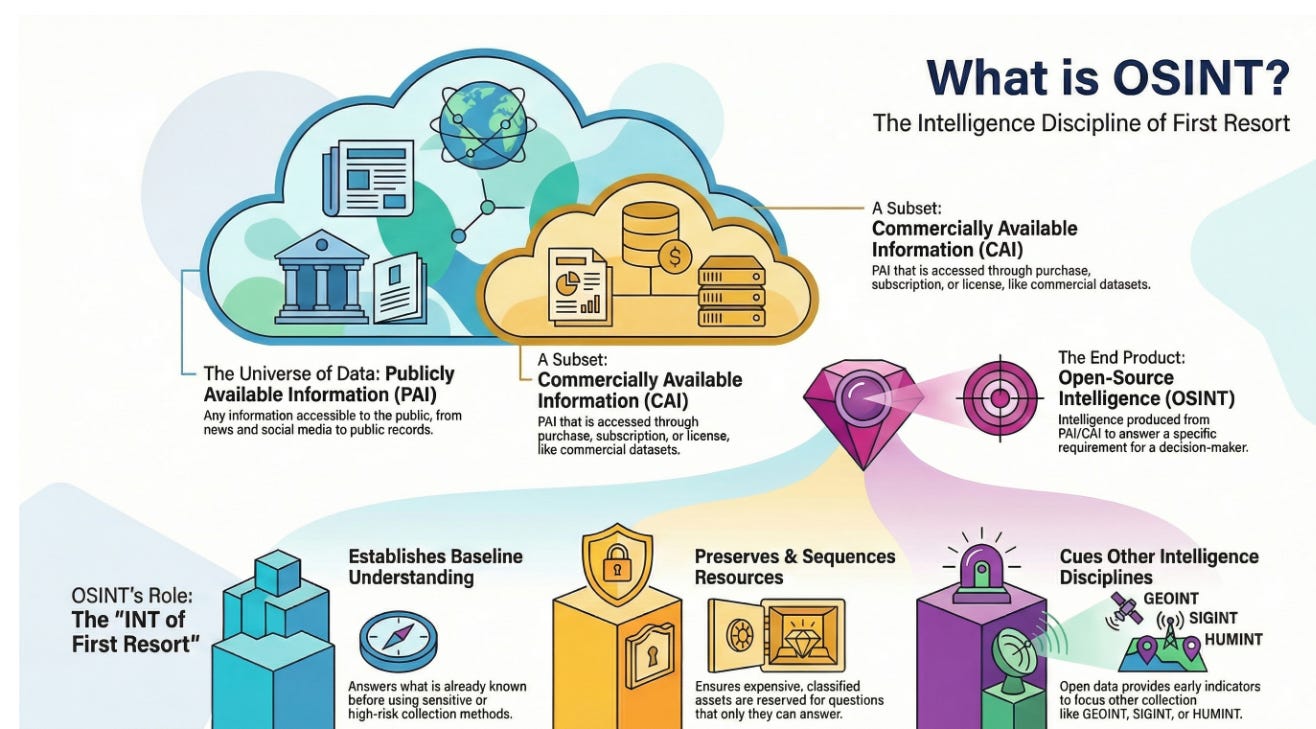
CAI is a subset of PAI. It’s still publicly accessible information, just accessed through a paid or licensed channel instead of being freely available. CAI is used constantly, even when the label itself isn’t. Commercial datasets, subscription services, licensed imagery, financial data, and proprietary reporting support journalism, corporate security, market research, and investigative work across sectors.
Within the intelligence enterprise, CAI sits inside the open-source environment and is evaluated and integrated alongside other open sources using standard tradecraft. Outside the enterprise, the same material supports reporting, investigations, and business analysis without being part of an intelligence process. Whether work with CAI constitutes OSINT depends on how it is tasked, analyzed, and used in support of a decision-maker.
The OSINT Source Environment and Analytic Work
The OSINT source environment is broad and varied. Practitioners work with media reporting, commercial datasets, public records, imagery, technical publications, corporate filings, shipping and aviation data, and observable activity in public spaces. These sources are overt, but they are not self-validating. Practitioners evaluate source reliability, assess information credibility, and situate reporting within political, economic, cultural, and geographic context before it contributes to analytic judgment.
We know by now that collection alone does not produce intelligence. After information is gathered, analysts examine consistency across sources, identify gaps, evaluate alternative explanations, and assess what the available information suggests about future conditions. OSINT products are expected to express analytic judgment clearly, describe uncertainty explicitly, and support decisions rather than document activity.
Within intelligence organizations, OSINT follows the same intelligence process as other disciplines. Work is driven by requirements, products are coordinated and integrated, and judgments are expected to stand alongside reporting from classified sources. OSINT occupies the same analytic space as other INTs and is subject to the same expectations for rigor, transparency, and accountability.
OSINT as the Discipline of First Resort
Jason Barrett, IC’s OSINT Executive at the ODNI has called OSINT “the INT of first resort” because it establishes baseline understanding before more sensitive collection is employed (Public Law 109-163 2006; FM 2-0 2023; IC OSINT Strategy 2024–2026 2024). This reflects how intelligence work is sequenced across the enterprise and how risk, cost, and availability shape collection decisions.
Earlier NATO and joint frameworks emphasized OSINT as a foundational source of contextual knowledge rather than as a lead analytic discipline (SACLANT 2002; NATO 2002). Practitioners relied on open sources to develop historical, cultural, political, and geographic understanding so classified reporting could be interpreted accurately once it arrived. That role remains central to OSINT today.
OSINT practitioners are expected to establish what is already observable in the open and commercial environment before tasking sensitive capabilities. Working the problem this way preserves resources, limits unnecessary exposure, and ensures classified collection is applied with clear intent rather than by default.
OSINT also provides speed. In unfamiliar regions or during emerging crises, open sources are often the only means of producing immediate situational awareness while classified systems reposition or begin collection (Steele 1996; FM 2-0 2023). Early analytic framing shapes how later reporting is interpreted and where additional collection effort is directed.
OSINT sets the outer boundaries of the problem space. Political conditions, economic constraints, social dynamics, infrastructure, geography, and publicly observable behavior define the environment where sensitive reporting has to be interpreted (NATO 2002). Practitioners use that baseline to separate what’s known from what’s still uncertain and to spot where additional collection is likely to produce real analytic return.
Starting with publicly available information is institutional discipline, not preference. Intelligence organizations aren’t expected to spend scarce or high-risk capabilities collecting information that’s already observable in the public domain (Steele 1996; FM 2-0 2023). OSINT helps sequence collection deliberately, keeping sensitive resources for questions that can’t be answered any other way.
Cueing, Tipping, and Collection Focus
OSINT plays a central role in shaping how other intelligence disciplines are used. Open reporting often provides the first indication that conditions have shifted. Media coverage, commercial imagery, shipping and aviation data, financial disclosures, and public records routinely identify observable activity before classified sensors are redirected (JP 2-0 2013; NATO 2002).
This early visibility allows analysts to focus collection. Activity identified through OSINT can cue GEOINT confirmation, which may then drive SIGINT or HUMINT tasking against specific targets or networks (JP 2-0 2013; FM 2-0 2023). Sequencing collection this way preserves sensitive assets and improves efficiency across the enterprise. OSINT informs when additional collection is needed and where it is most likely to contribute to analytic understanding.
Evaluation, Weighting, and Analytic Discipline
OSINT is evaluated using the same analytic tradecraft standards applied to other intelligence reporting (ICD 203 2015). Practitioners assess source reliability and information credibility separately. Source corroboration is expected. Observations, inferences, and judgments are distinguished clearly. Assumptions and uncertainty are stated explicitly (FM 2-0 2023; NATO 2002).
The open environment adds scale, speed, and volume. Practitioners have to account for bias, coordinated amplification, manipulation, and denial and deception, especially in information environments saturated with synthetic media and influence activity (Heuer 1999; DoD OSINT Strategy 2024). Those conditions raise the bar for analytic discipline rather than lowering it.
Professionalization and Governance
Professionalization starts with people. Civilian and military career tracks are being formalized so OSINT practitioners can build and retain expertise over time instead of rotating through open-source work as a peripheral assignment (DoD OSINT Strategy 2024). Tradecraft is being standardized across the enterprise, with performance measured by analytic judgment and decision support rather than by the volume of material collected. The focus is on producing intelligence, not accumulating data.
Training reflects that shift in expectations. Institutional programs, including the Open Source Academy, emphasize advanced research skills, analytic rigor, and data literacy rather than tool familiarity or platform-specific workflows (ATP 2-22.9 2012; IC OSINT Strategy 2024). Practitioners are trained to evaluate credibility, manage uncertainty, and integrate open reporting with other sources in ways that stand up to scrutiny.
Governance is handled at the enterprise level. The Director of the CIA serves as the OSINT Functional Manager, overseeing a federated system in which all 18 Intelligence Community organizations participate in standards development, coordination, and capability alignment (IC OSINT Strategy 2024). That structure is designed to keep OSINT integrated across the enterprise while allowing individual organizations to apply it against their specific missions.
Technology, Scale, and Human Judgment
Modern OSINT operates at a scale not anticipated in early frameworks. Machine-assisted collection and processing support analysis of data produced by hundreds of millions of websites and billions of connected devices, enabling near-real-time situational awareness (DoD OSINT Strategy 2024). Artificial intelligence supports summarization, association, and pattern recognition, allowing analysts to focus on interpretation rather than manual processing (DoD OSINT Strategy 2024; IC OSINT Strategy 2024).
These tools increase the consequences of weak tradecraft. Current strategies emphasize mitigating hallucination, source laundering, and automated amplification of disinformation (IC OSINT Strategy 2024). Analytic responsibility remains human.
There’s so much more to be said here, and this touches on my dissertation topic, so I will have a different article on human-machine teaming in the OSINT environment in the future. For now, we will pause here and come back to it later!
Data, Disinformation, and the Operating Environment
Publicly and commercially available information has become a global commodity, requiring coordinated acquisition and governance (DoD OSINT Strategy 2024). Strategies emphasize unified purchasing of CAI, shared catalogs, and enterprise-wide discoverability to reduce redundancy and improve analytic access (IC OSINT Strategy 2024; DoD OSINT Strategy 2024).
The operating environment is shaped by deliberate manipulation. Synthetic media, coordinated influence campaigns, and fragmented information ecosystems complicate evaluation and attribution (DoD OSINT Strategy 2024; Heuer 1999). Controlled-capture techniques, cryptographic hashing, and provenance validation support analytic confidence in imagery and video (Murray and Çalı 2024; DoD OSINT Strategy 2024).
Much publicly available information now resides beyond the indexed surface web. Estimates place Deep Web content hundreds of times larger than the surface web, requiring specialized query techniques and analytic approaches (SACLANT 2002; ATP 2-22.9 2012; DoD OSINT Strategy 2024).
Partnerships and Where the Field Is Now
Future OSINT effectiveness depends on partnerships across industry, academia, and allied intelligence services (IC OSINT Strategy 2024; INR OSINT Strategy 2024). Unclassified environments support faster experimentation, while international partnerships enable shared situational awareness in priority regions such as the Indo-Pacific (DoD OSINT Strategy 2024; IC OSINT Strategy 2024).
OSINT operates at scale, under uncertainty, and in direct support of decisions. Practitioners who work within this framework define their work by requirements, integration, and analytic outcomes rather than by tools. They understand why fusion matters, why single-source conclusions fail, and why OSINT sits inside the intelligence enterprise as a full discipline.
Closing
OSINT sits inside the intelligence enterprise as a full discipline, defined by requirements, standards, and analytic accountability. Its sources may be public, but its purpose is disciplined and consequential. Practiced correctly, OSINT establishes baseline understanding, shapes collection decisions, and strengthens analytic judgment across every other intelligence discipline.
OSINT does not replace classified collection. It prepares the analytic ground, constrains interpretation, and ensures sensitive capabilities are applied deliberately. Inside the enterprise, its value is measured by how well it supports decisions under uncertainty.