What is MASINT?
The Intelligence Fundamentals Project

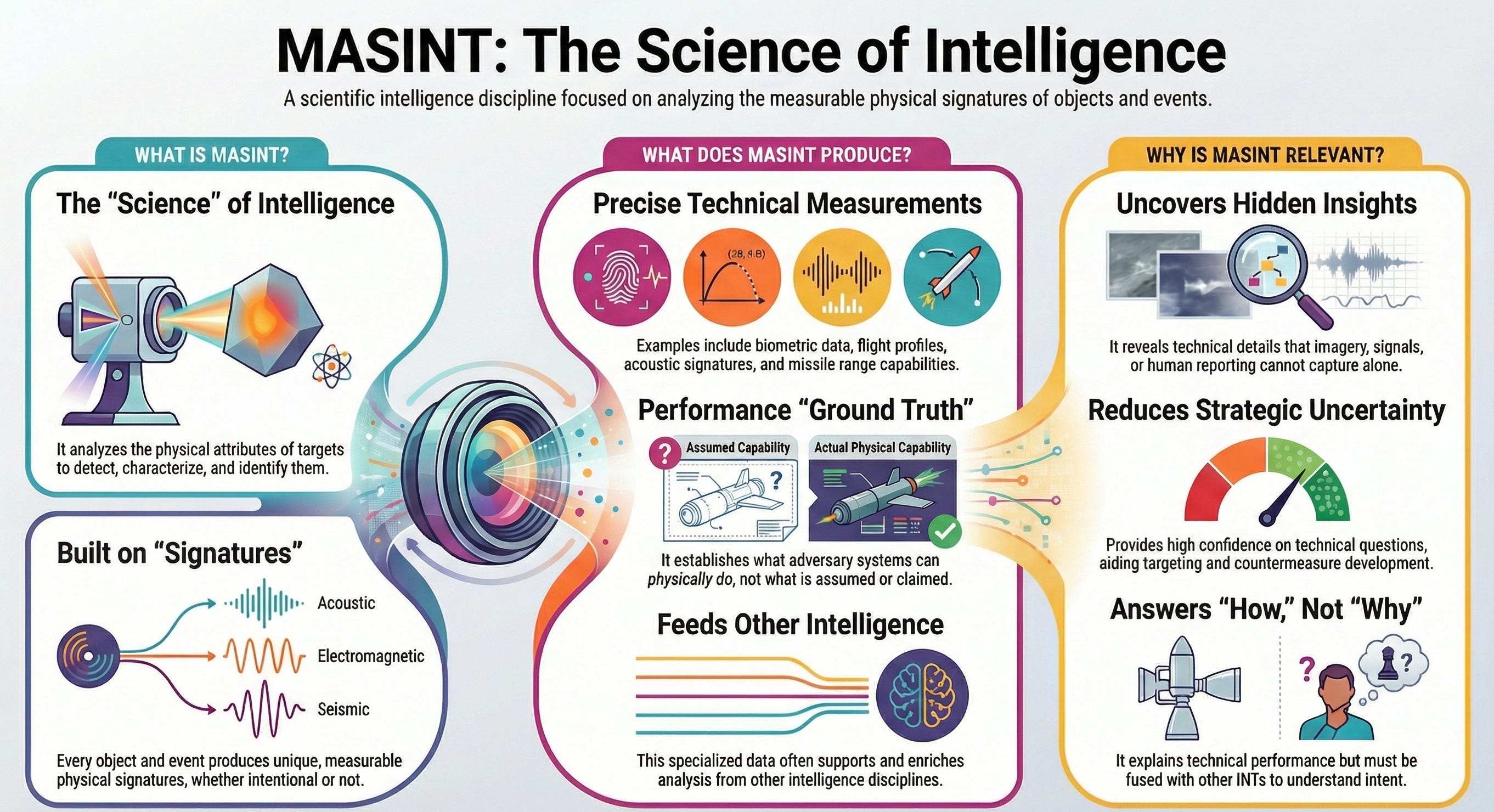
Measurement and Signature Intelligence is about understanding the physical world as it actually behaves. It focuses on the scientific and technical characteristics of objects and events and turns those characteristics into usable intelligence. MASINT is often described as obscure or niche, largely because its methods rely on physics, engineering, and material science rather than observation or narrative reporting. That reputation tends to obscure what MASINT actually contributes inside the intelligence enterprise.
Doctrine defines MASINT as intelligence produced through the quantitative and qualitative analysis of physical attributes in order to detect, characterize, locate, and identify targets and events (JP 2-0 2022; FM 2-0 2023). These physical attributes appear as measurable signatures generated by real-world activity. They reflect how systems operate, how materials respond to stress or energy, and how events unfold in physical space. MASINT exists to answer questions that require technical certainty grounded in measurement.
MASINT does not attempt to answer every analytic question; its contribution is specific and technical. It focuses on performance, behavior, and physical characteristics that cannot be reliably inferred through observation, communications, or human reporting alone. Its analytic value emerges when its findings are integrated with other intelligence disciplines that provide context, intent, and decision-making insight.
At its foundation, MASINT rests on a simple principle. Every object and every event produces observable and measurable signatures, whether or not they are intentionally emitted (FM 2-0 2023). Understanding those signatures allows analysts to assess how systems function, how threats evolve over time, and how adversaries develop and field advanced capabilities.
What MASINT Produces
MASINT produces precise information about threat characteristics and system performance (FM 2-0 2023). It collects and analyzes technical data associated with warfighting equipment, people, developmental weapons programs, and emerging threats, including those related to weapons of mass destruction (FM 2-0 2023). This work is specialized and often supports other intelligence disciplines rather than appearing as a standalone finished product.
At its most concrete level, MASINT produces parameter measurements. These include biometric attributes, observed flight profiles, acoustic and seismic signatures, and missile range envelopes, among many others (FM 2-0 2023). These measurements establish what systems can physically do under real conditions. They replace assumption and assertion with demonstrable performance.
MASINT also develops signatures by aggregating measurements collected across time and conditions. Those signatures form the basis for classification profiles and for algorithms used by surveillance systems, defensive platforms, and weapons systems (FM 2-0 2023). This longitudinal perspective allows analysts to detect change, identify anomalies, and track development paths as systems mature, degrade, or are modified.
Beyond individual measurements, MASINT produces specialized scientific data across multiple domains, including electro-optical, radar, radio frequency, geophysical, materials, and nuclear-related measurements (JP 2-0 2022). This data underpins assessments of system design, performance limits, countermeasures, and technical risk, particularly where adversaries are developing unfamiliar or advanced capabilities.
Across the Intelligence Community, the Defense Intelligence Agency serves as the functional manager for MASINT, reflecting its central role in understanding adversary technology, research and development activity, and long-term capability evolution (FM 2-0 2023).
Why MASINT Is Structured Differently
MASINT is not organized around a single entry path or occupational specialty. Its workforce structure follows from the type of expertise the discipline requires. MASINT depends on scientific and engineering knowledge that must exist before intelligence tradecraft is applied.
The analytic work draws on physics, chemistry, materials science, biology, and multiple engineering disciplines. Analysts are expected to understand how physical systems behave, how materials respond to energy, and how measurable signatures are generated. That technical grounding usually comes through formal education and professional experience rather than through intelligence training alone (FM 2-0 2023; FBI 2025).
Intelligence training adds context, analytic standards, and security discipline. It teaches how to apply technical expertise inside classified environments and operational timelines. The technical competence itself is assumed rather than developed from scratch.
Because of this structure, MASINT capability is distributed across laboratories, test facilities, operational units, intelligence centers, and research organizations. Many contributors generate MASINT-relevant analysis without holding a dedicated MASINT title. The discipline functions through coordinated expertise rather than through a single workforce channel.
How MASINT Is Managed
MASINT is managed as a functional capability across the Intelligence Community. The Defense Intelligence Agency serves as the functional manager, setting standards, coordinating requirements, and integrating MASINT activity across organizations (FM 2-0 2023; JP 2-0 2022).
Management emphasizes certification, readiness, and analytic rigor. Personnel are selected through security and suitability vetting and then integrated into MASINT roles through discipline-specific training and operational alignment (FM 2-0 2023; FBI 2025). In military contexts, training and skill sustainment are governed by the Military Intelligence Training Standard and supported through the Foundry program (Department of the Army 2023).
Senior Science and Technology Officers play a coordinating role across this structure. They ensure that scientific methods are applied correctly in intelligence work and that MASINT activities meet operational requirements, particularly when specialized sensors, detectors, and technically complex collection systems are involved (JP 2-0 2022; FM 2-0 2023).
How MASINT Is Used Across Analysis
Most analysts encounter MASINT through its outputs rather than through direct involvement in its collection or measurement. Those outputs often appear as performance limits, technical constraints, or validated measurements embedded within finished intelligence.
These contributions shape analytic judgment by bounding what systems can physically do, how they behave over time, and where uncertainty remains. MASINT-derived findings inform assessments of capability, feasibility, and risk without requiring every analyst to work at the level of raw technical data.
When MASINT is treated as a standalone specialty rather than as a shared analytic input, its contribution can be misunderstood or underweighted. Its role is to ground analysis in measurable reality and to constrain interpretation where other reporting leaves room for assumption.
Why MASINT Is Relevant
MASINT provides insight into aspects of threats that cannot be resolved through imagery, communications intercepts, or human reporting alone. It allows analysts to understand how systems function rather than how they are described or demonstrated. This makes MASINT essential for assessing advanced weapons, emerging technologies, and novel operational concepts where performance details matter.
MASINT supports targeting, countermeasure development, weapons system design, and battle damage assessment by reducing uncertainty around technical feasibility and system performance (FM 2-0 2023). It also informs research and development by identifying strengths, limitations, and vulnerabilities in adversary capabilities before they are fully fielded.
While MASINT delivers high confidence in specific technical findings, it does not address intent, strategy, or decision-making. Its outputs answer technical questions. Their analytic value increases when they are integrated with reporting that explains behavior, motivation, and operational context.
How OSINT Supports MASINT
OSINT supports MASINT by providing context for technical measurement and analysis. Physical signatures require interpretation, and that interpretation depends on understanding the scientific, industrial, and programmatic environment in which those signatures are produced.
Open-source information helps describe the technological base, infrastructure, and development pathways surrounding a capability or facility (SACLANT 2002; JP 2-0 2022). Public research papers, patent filings, procurement records, budget documents, trade publications, and industry reporting often reveal early indicators of testing, development, or construction activity.
Within all-source analysis, OSINT fills gaps, tests assumptions, and provides reference points that help integrate MASINT findings with HUMINT, SIGINT, GEOINT, and counterintelligence reporting (FM 2-0 2023). MASINT contributes technical truth. OSINT situates that truth within observable economic, scientific, and organizational reality.
OSINT also supports counterintelligence related to MASINT by identifying foreign research institutions, commercial partnerships, supply chains, and indicators of technical collection risk (FM 2-0 2023). That context helps protect sensitive capabilities and assess adversary intelligence activity tied to scientific and technical collection.
MASINT Inside All-Source Analysis
MASINT’s defining strength is precision. It detects, characterizes, and identifies physical phenomena that other intelligence disciplines cannot directly access. That precision becomes analytically meaningful when it is integrated with other forms of reporting.
When combined with HUMINT insights, SIGINT intercepts, GEOINT reporting, counterintelligence findings, and OSINT context, MASINT constrains analytic judgment. It validates reporting, challenges assumptions, and sharpens assessments of capability and risk by anchoring conclusions in measurable reality.
MASINT delivers measurements, signatures, and technical clarity. Inside the intelligence enterprise, those contributions matter because they keep analytic judgment grounded in physical fact rather than inference alone.
Closing
MASINT establishes the measurable parameters that govern intelligence assessment. It defines how systems emit energy, respond to stress, perform under operating conditions, and change over time. These measurements determine the technical bounds within which analytic judgment operates.
Within the intelligence enterprise, MASINT provides verified performance data that informs assessments of capability, reliability, and risk. Those findings support analytic confidence by grounding judgments in observed physical behavior. When integrated with other reporting, MASINT ensures that conclusions remain consistent with material, engineering, and environmental realities.
MASINT’s contribution is sustained analytic discipline. It keeps intelligence judgments aligned with what systems demonstrably do under real conditions by tying assessments to measurable phenomena.