What is All-Source Intelligence?
The Intelligence Fundamentals Project

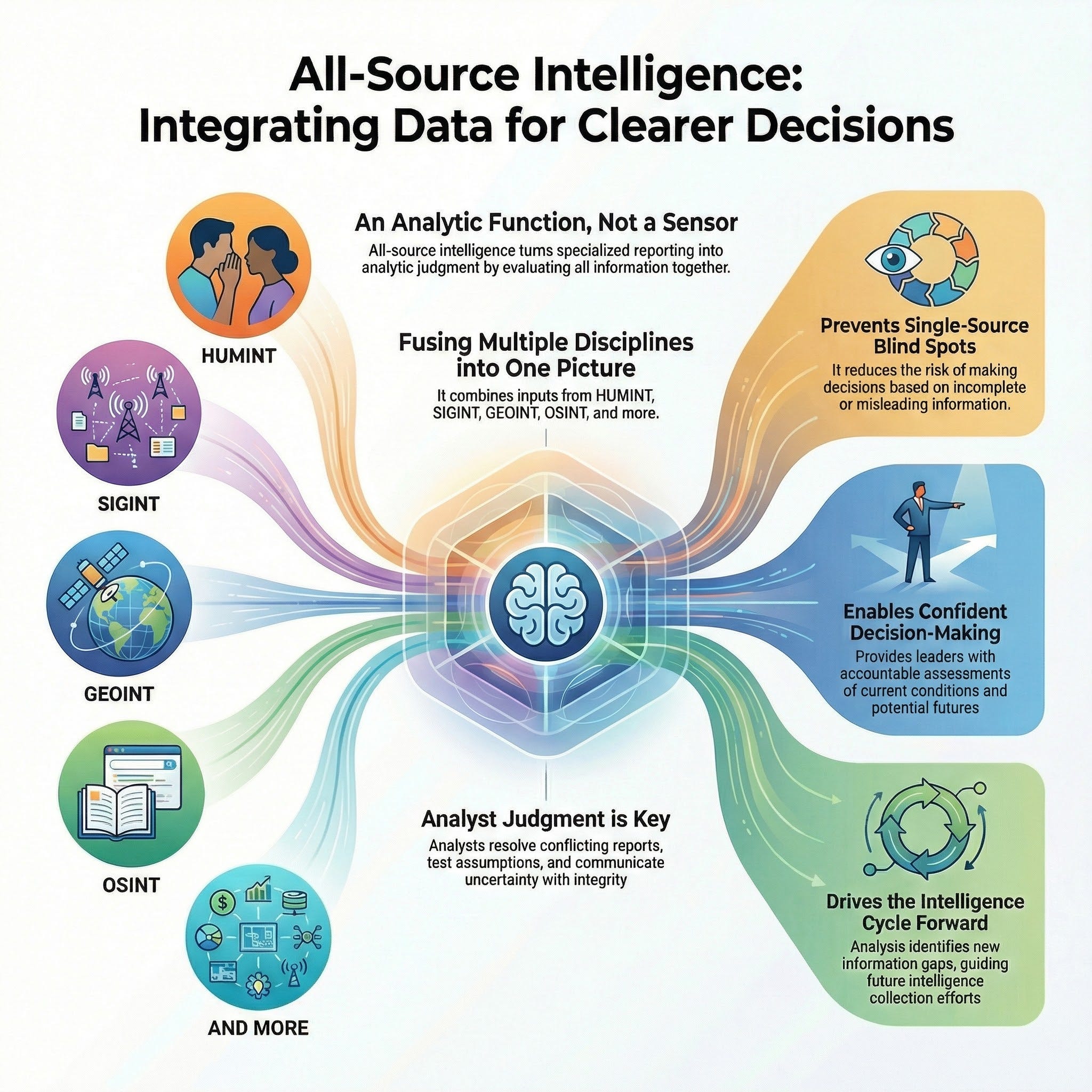
The intelligence enterprise doesn’t function through isolated disciplines. It functions through integration, and that integration happens inside all-source intelligence. All-source intelligence is where information from across the enterprise is brought together to produce assessments that help commanders, investigators, and decision-makers understand current conditions and anticipate what may happen next.
This is where individual streams of reporting stop standing alone and begin forming a coherent picture. All-source intelligence turns specialized reporting into analytic judgment by forcing information to be evaluated together, not accumulated separately.
What All-Source Intelligence Is Doctrinally
Joint doctrine defines all-source intelligence as intelligence products and activities that incorporate all sources of information in the production of finished intelligence (JP 2-0 2022). Army doctrine explains that all-source intelligence integrates intelligence and information from all relevant sources to analyze situations or conditions that affect operations (FM 2-0 2023).
These definitions are intentionally broad. All-source intelligence isn’t a sensor, a platform, or a single discipline. It’s an analytic function that brings together everything the enterprise can collect, process, and evaluate. The emphasis isn’t on access to information. It’s on integration and interpretation.
All-source intelligence exists to prevent decisions from being shaped by single-source conclusions. It forces comparison, tests assumptions, and reduces the risk of acting on incomplete or misleading reporting.
Where Analytic Judgment and Responsibility Live
All-source intelligence is where analytic responsibility becomes explicit. Commanders define intelligence requirements and organizations synchronize effort, but analysts own the judgments that emerge from integrated reporting.
That responsibility includes deciding which information carries weight, how conflicts between sources are resolved, and how uncertainty is communicated. Analysts are expected to apply rigorous reasoning and professional integrity, remain independent of political or operational pressure, and present judgments clearly even when the evidence is incomplete (ODNI ICD 203 2015; JP 2-0 2022). This is the point where intelligence stops being a shared awareness exercise and becomes accountable assessment.
How All-Source Intelligence Works
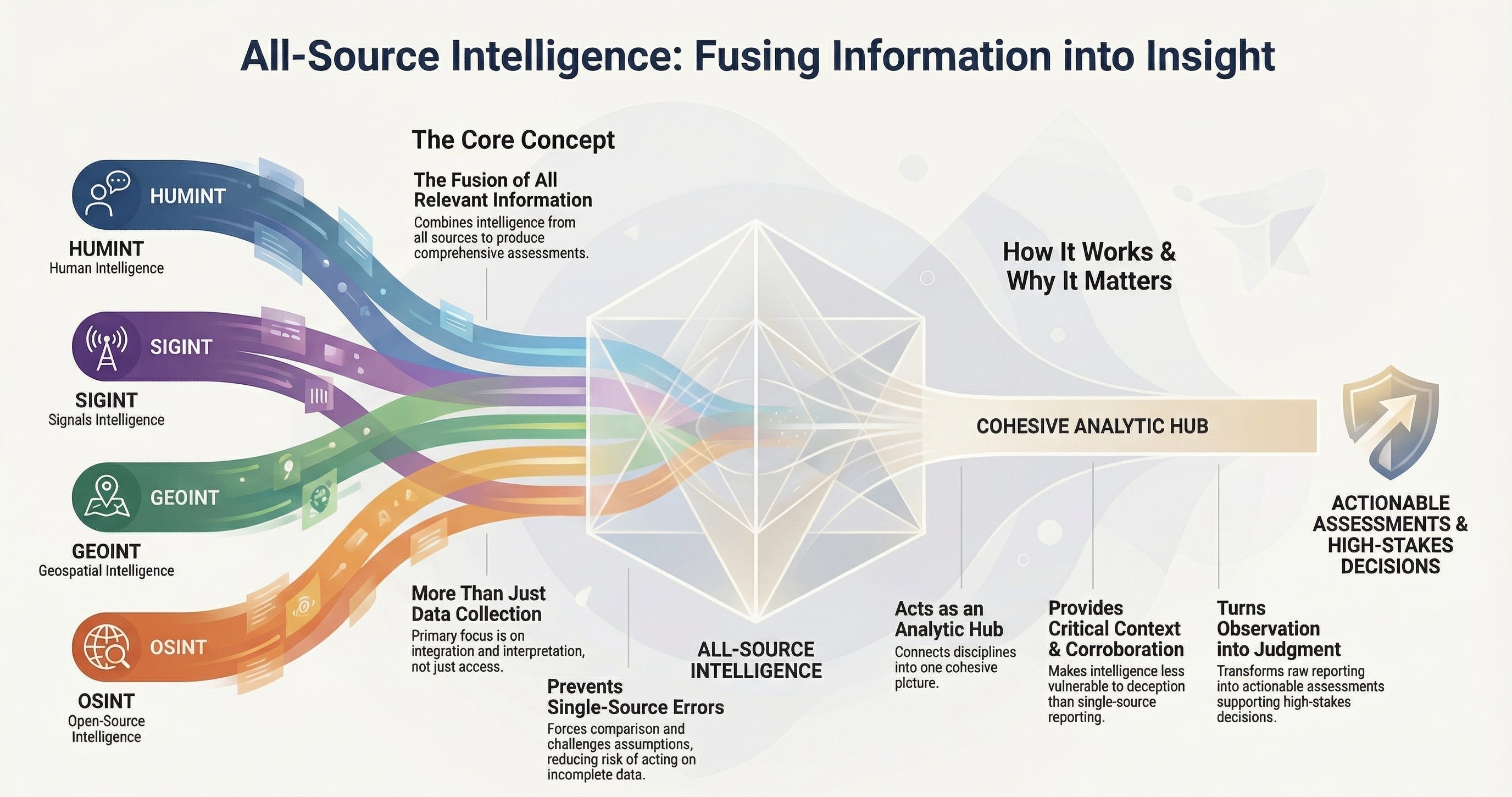
All-source intelligence functions as the analytic hub that connects every intelligence discipline. Doctrine consistently ties all-source production to fusion, multidiscipline analysis, and continuous support to operations and decision-making.
Fusion consolidates, combines, and correlates information across the enterprise to refine understanding and strengthen analytic confidence (FM 2-0 2023). Multidiscipline analysis requires analysts to evaluate inputs from HUMINT, SIGINT, GEOINT, MASINT, counterintelligence, OSINT, and specialized technical sources together rather than separately (JP 2-0 2022). Continuous production reflects the reality that all-source intelligence supports decisions before, during, and after operations, not at a single moment (FM 2-0 2023).
This work happens under conditions of partial visibility. Conflicting reporting is normal. All-source analysis examines why sources disagree, what each source is positioned to observe, and what that tension reveals about the environment.
Handling Conflict and Uncertainty
All-source intelligence doesn’t aim to eliminate uncertainty. It manages it. Analysts are required to describe what is known, what is assessed, and what remains unclear so decision-makers understand the level of risk involved.
Doctrine requires analysts to express both likelihood and confidence, explain the basis for uncertainty, and ground confidence in sourcing diversity, assumptions, and the strength of the analytic argument (ODNI ICD 203 2015; JP 2-0 2022). Each piece of information is evaluated independently for reliability and credibility, rather than assumed to be trustworthy through repetition or superficial corroboration (AFDP 2-0 2023). This discipline allows intelligence to function under ambiguity without overstating certainty or obscuring risk.
All-Source Intelligence and the Intelligence Cycle
All-source intelligence doesn’t just integrate reporting after it arrives. It shapes what the enterprise does next. As analysts fuse information, they identify gaps, inconsistencies, and priority questions that still need answers.
Doctrine places all-source intelligence at the center of the intelligence cycle. Mission analysis leads to Priority Intelligence Requirements and Essential Elements of Information, which are translated into indicators and specific collection requirements to task assets across disciplines (JP 2-0 2022; FM 2-0 2023). Evaluation and feedback occur continuously, allowing analysts to refine requirements and redirect collection as conditions change (AFDP 2-0 2023).
This feedback loop keeps intelligence aligned with what decision-makers actually need to understand, not just what the enterprise happens to be collecting.
All-Source Intelligence as a Continuous Analytic Process
All-source intelligence is a continuous analytic activity rather than a sequence that ends with publication. Integration happens during triage, evaluation, hypothesis testing, and reassessment, not just during final production.
Doctrine emphasizes ongoing dialogue between producers and users, with assessments revisited as environments evolve and new information emerges (JP 2-0 2022). Analysts maintain running estimates and shared analytic pictures that support interpretation over time rather than snapshot conclusions (FM 2-0 2023).
Finished intelligence products are outputs of this process, not the entirety of the function.
Why All-Source Intelligence Matters
All-source intelligence supports situational understanding, decision-making, and targeting across the enterprise (JP 2-0 2022). It provides the context analysts need to interpret reporting within the operational environment instead of treating individual reports as self-contained explanations (FM 2-0 2023).
By requiring corroboration and cross-comparison, all-source analysis reduces vulnerability to deception and misinterpretation (FM 2-0 2023). It allows analysts to focus on adversary behavior, motivation, and likely future actions rather than reacting to isolated events (ADP 2-0 2023). It also draws on knowledge of demographics, culture, terrain, infrastructure, and political and social systems to produce assessments that reflect how environments actually function (AFDP 2-0 2023).
All-source intelligence is how the enterprise produces intelligence rather than raw reporting.
Integration Takes Active Analytic Effort
Integration across disciplines doesn’t happen automatically. Different intelligence functions operate on different timelines, apply different confidence standards, and prioritize different problems.
Doctrine identifies persistent challenges such as stove-piping, compartmentation, degraded communication, and circular reporting as risks to effective fusion (JP 2-0 2022; FM 2-0 2023). All-source intelligence exists because these frictions require active analytic effort to manage. Integration is a skill and a function, not a default condition created by shared systems.
OSINT’s Role in All-Source Intelligence
Open-source intelligence plays a direct role in strengthening all-source production. When integrated deliberately, OSINT fills gaps, adds context, and improves the quality of analytic judgment.
Doctrine describes open-source information as essential for understanding classified reporting and the environments in which that reporting was collected (FM 2-0 2023; JP 2-0 2022). OSINT helps fill gaps in classified holdings and improves the accuracy and completeness of intelligence databases (JP 2-0 2022; FM 2-0 2023). Analysts are expected to evaluate classified and open-source material together as part of rigorous all-source production.
OSINT also contributes publicly available data, cultural insight, infrastructure information, and observable trends that support interpretation and grounding.
What This Means for OSINT Practitioners
When OSINT is understood within the all-source framework, it operates as part of a broader analytic system rather than a standalone activity.
OSINT findings are expected to be corroborated, contextualized, and weighed alongside other intelligence. Requirements shape what gets collected and why. OSINT functions as one discipline among many and often establishes the baseline understanding that enables deeper analysis.
For practitioners, this means OSINT contributes directly to assessments that shape operations, policy decisions, and investigations. Its value shows up through integration and analytic impact.
Closing
All-source intelligence is the function that keeps the enterprise from fragmenting into disconnected expertise. It’s where information becomes judgment, uncertainty is handled directly, and responsibility for assessment is made explicit. When it’s done well, collection, analysis, and decision-making reinforce each other. When it isn’t, the enterprise still produces reporting, but it loses coherence.