The Intelligence Cycle: An Overview
The Intelligence Fundamentals Project

What is “the Intelligence Cycle”?
When people talk about “the intelligence cycle,” they’re usually referring to the way their organization explains how intelligence work gets done. Most of us have a diagram or a process in mind that we learned early on, and inside that context it makes sense to talk about it as a single cycle.
Across the broader intelligence enterprise, though, there isn’t one universal intelligence cycle that everyone follows in the same way. What exists instead is a shared concept that different organizations express through different cycle models, each shaped by mission, authority, legal constraints, and operating environment. Those models vary in how many steps they show, what they emphasize, and how they label different activities, but they’re all trying to describe the same underlying work.
At its core, “the intelligence cycle” is a way of describing how organizations turn raw information into intelligence that supports decisionmaking over time. That work begins with a requirement, moves through collection, processing, and analysis, gets delivered to people who have to decide or act, and then generates feedback that reshapes the next set of questions. The structure changes from one model to another, but the logic remains consistent enough that practitioners can recognize it across disciplines and organizations.
Rather than a single fixed diagram, the intelligence cycle is best understood as a shared logic expressed through different executions. Each model explains how information moves across teams and functions, how judgment gets applied along the way, and how uncertainty is managed as conditions change. These models operate at the enterprise level, showing how intelligence work holds together across multiple actors and activities instead of residing in any single role or step.
Across the Intelligence Community, the military, and law enforcement, intelligence cycles provide a common way to describe how intelligence functions at scale. Joint and Air Force doctrine describe the intelligence process as a set of interrelated categories of intelligence operations that establish shared structure and terminology (JP 2-0 2022; AFDP 2-0 2023). Law enforcement doctrine describes a criminal intelligence cycle that organizes planning, collection, processing, analysis, dissemination, and reevaluation into a continuous loop designed to support accountable action (OSCE 2017; Global Justice Information Sharing Initiative 2003).
Intelligence cycles are usually depicted as loops because intelligence work continues beyond the delivery of a product. Finished intelligence generates feedback, exposes gaps, and reshapes requirements, starting the next iteration of the cycle with clearer focus and better-defined risk.
Why Intelligence Cycles Exist
The intelligence cycle exists because information arrives fragmented, uneven in quality, and shaped by collection conditions. Reports come from different sources, at different times, and with different levels of reliability and relevance. Data often reflects how and where it was collected. Without a structured way to guide tasking, evaluate inputs, apply judgment, and revisit assumptions, intelligence work accumulates information faster than it produces understanding.
Military and Intelligence Community doctrine define the purpose of the intelligence cycle as providing commanders and national-level decision-makers with relevant and timely intelligence and enabling intelligence to be integrated and synchronized with operations (JP 2-0 2022; AFDP 2-0 2023). In operational terms, the cycle connects intelligence activity to decision-making timelines and priorities.
Law enforcement doctrine describes the same function in action-oriented terms. The criminal intelligence cycle exists to transform raw data and information into value-added intelligence intended to inform operational and strategic decisions (OSCE 2017). That framing reflects the need for intelligence to support decisions that carry legal, public, and organizational accountability.
Across contexts, the intelligence cycle functions as a risk management mechanism. It structures how organizations define information needs, assess the quality of what they collect, apply analytic judgment, and communicate uncertainty alongside conclusions.
The Main Intelligence Cycle Models You’ll Encounter
When people refer to “the intelligence cycle,” they aren’t always talking about the same diagram. Different communities use different cycle models to describe the same underlying work. The models vary in how many steps they show, what they emphasize, and how they name activities, but they are all attempts to describe how intelligence moves from requirement to decision. At a high level, these are the cycle models you will most commonly see:
Joint & Air Force Intelligence Cycle
Joint and Air Force doctrine describe the intelligence cycle as a six-phase model that provides a shared structure and common terminology for intelligence operations across the joint force. This is used across much of the Intelligence Community as well as in the Army (even though they also have their own process outlined, and discussed below). It is designed to support commanders and national-level decision-makers by managing intelligence activity from initial requirements through evaluation and feedback (JP 2-0 2022; AFDP 2-0 2023).
The six phases are:
Planning and Direction - defining intelligence requirements and translating commander intent or policy priorities into tasking
Collection - acquiring information in response to those requirements
Processing and Exploitation - converting raw collected data into usable formats
Analysis and Production - integrating and evaluating information to produce intelligence judgments
Dissemination and Integration - delivering intelligence and integrating it into decision-making processes
Evaluation and Feedback - assessing performance and reshaping requirements
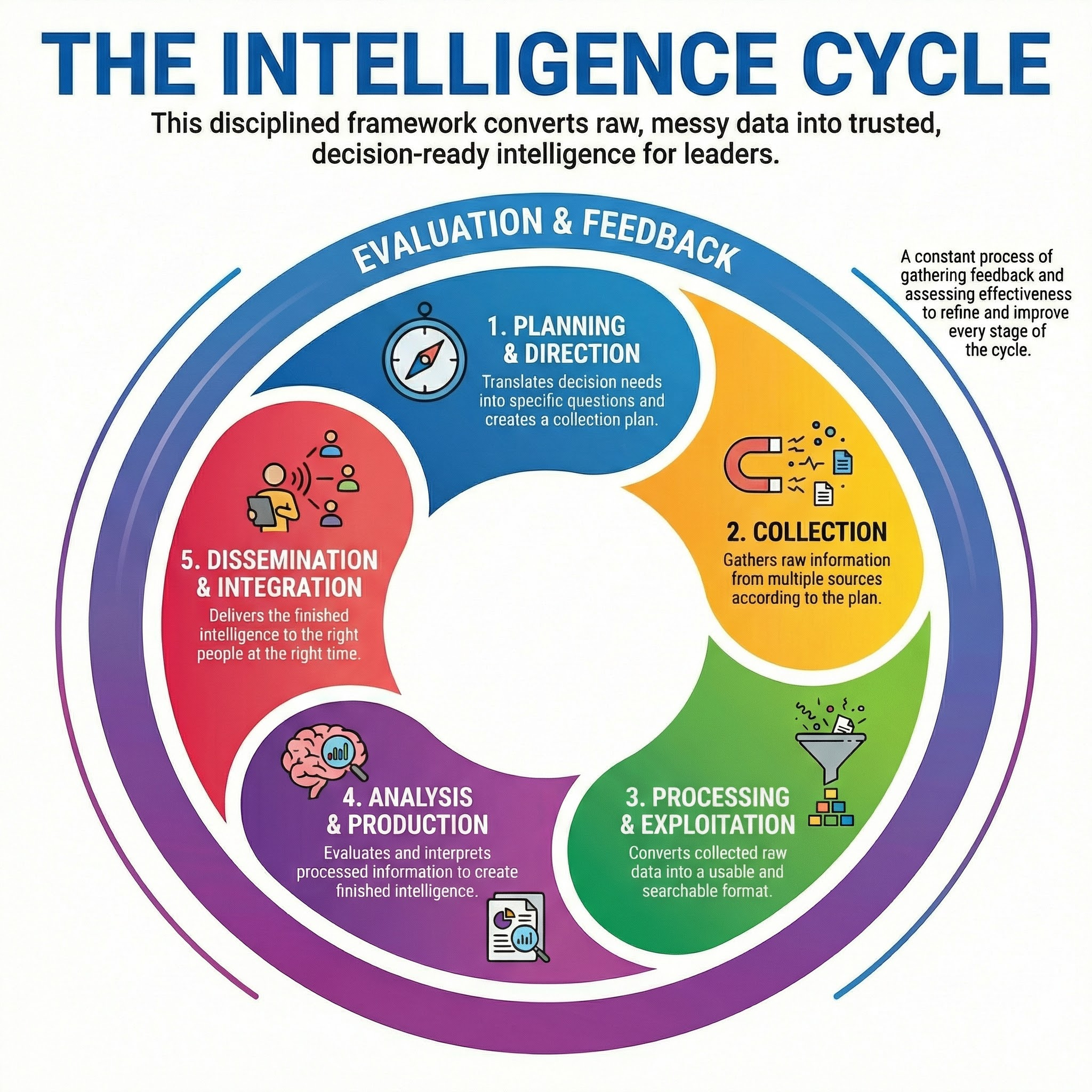
This model is built for a federated intelligence environment. Combatant commands rely on support from across the Intelligence Community, and the cycle explicitly accounts for distributed production and reachback. Evaluation and feedback operate continuously rather than at the end, reinforcing the idea that intelligence activity is constantly being adjusted based on performance and changing conditions (Department of the Air Force 2023).
Doctrine also acknowledges operational time pressure. In some situations, phases may be compressed and information may move forward without full analysis when speed is essential. That flexibility reflects operational reality while still keeping evaluation and feedback tied to the system (Joint Chiefs of Staff 2013).
U.S. Army Intelligence Process
The U.S. Army describes the intelligence process as a model to guide thinking and planning, closely tied to the Army operations process of plan, prepare, execute, and assess. It uses a compressed structure that emphasizes continuity and integration with maneuver and fires rather than a step-by-step workflow (Department of the Army 2023).
The four steps are:
Plan and Direct
Collect and Process
Produce
Disseminate and Integrate
These steps are supported by continuing activities that occur throughout the process, including analysis, assessment, synchronization, intelligence operations, and processing, exploitation, and dissemination (PED).
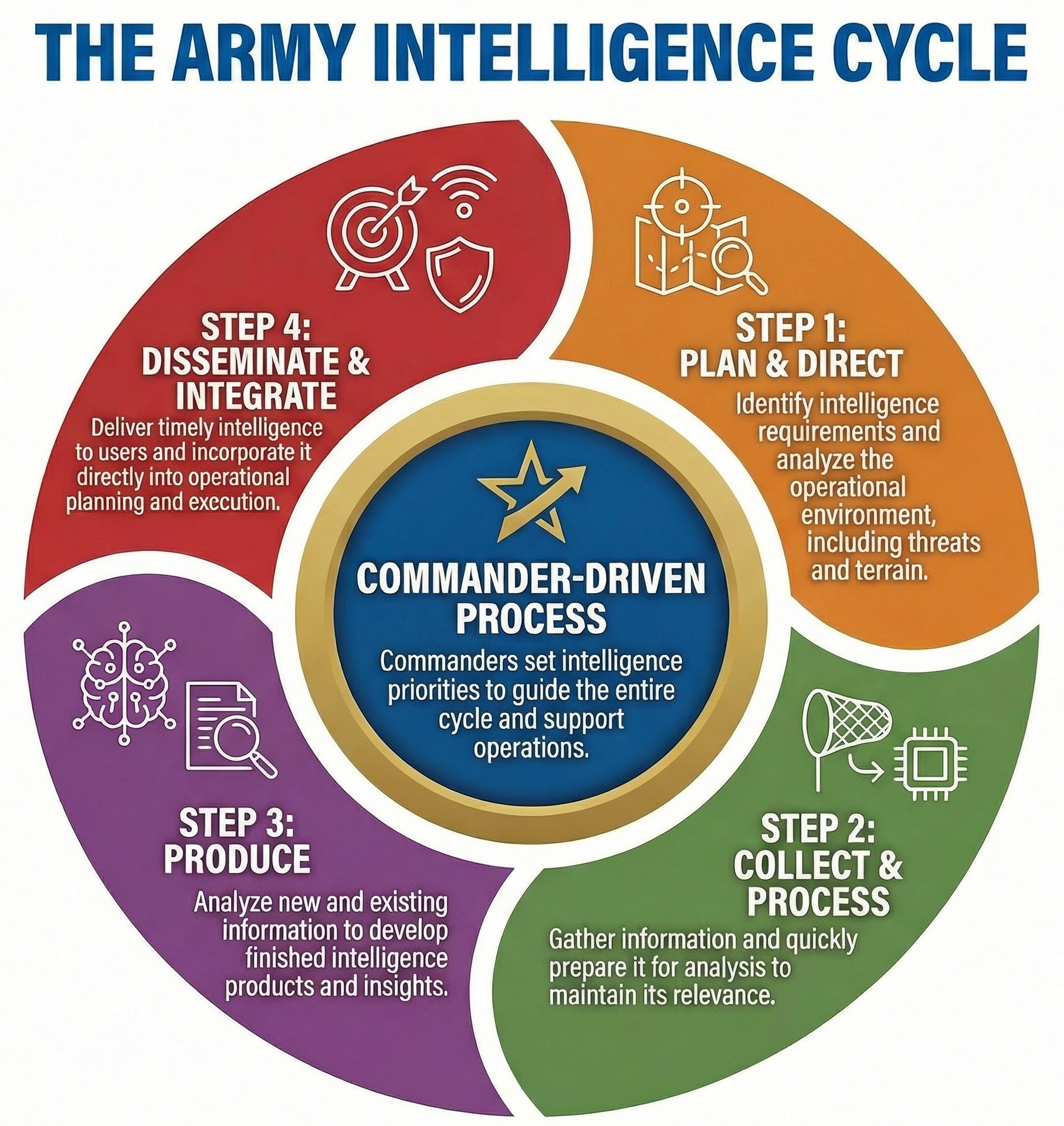
This framing reflects the realities of land operations and large-scale combat. Commanders drive intelligence priorities, and intelligence staffs synchronize collection, analysis, and dissemination in direct support of operations. The emphasis on continuing activities reinforces that assessment and analysis do not wait for a final phase but persist as conditions change.
Army doctrine also explicitly addresses the challenges of operating in contested environments. The process is designed to function under conditions of uncertainty, deception, and information overload, with increasing attention paid to data literacy and the ability of analysts to manage complex information flows (Department of the Army 2023).
Law Enforcement Criminal Intelligence Cycle
What you’ll notice here is a very distinct similarity to the Joint and Air Force cycle we discussed above, with slightly different terminology (like ‘collation’ and ‘re-evaluation’). Law enforcement doctrine describes criminal intelligence as the result of a structured cycle designed to support lawful, accountable decision-making. While the overall flow resembles military intelligence cycles, the law enforcement model places more emphasis on evaluation, recording, and reviewability (Global Justice Information Sharing Initiative 2003; OSCE 2017).
Commonly described phases include:
Planning and Direction / Tasking
Information Collection
Evaluation
Processing and Collation
Analysis
Dissemination
Reevaluation and Feedback
Evaluation is a distinct and explicit requirement in this model. Sources and information are graded for reliability and validity before analysis, often using standardized coding systems. Processing and collation organize evaluated information into systems that allow retrieval, audit, and oversight.
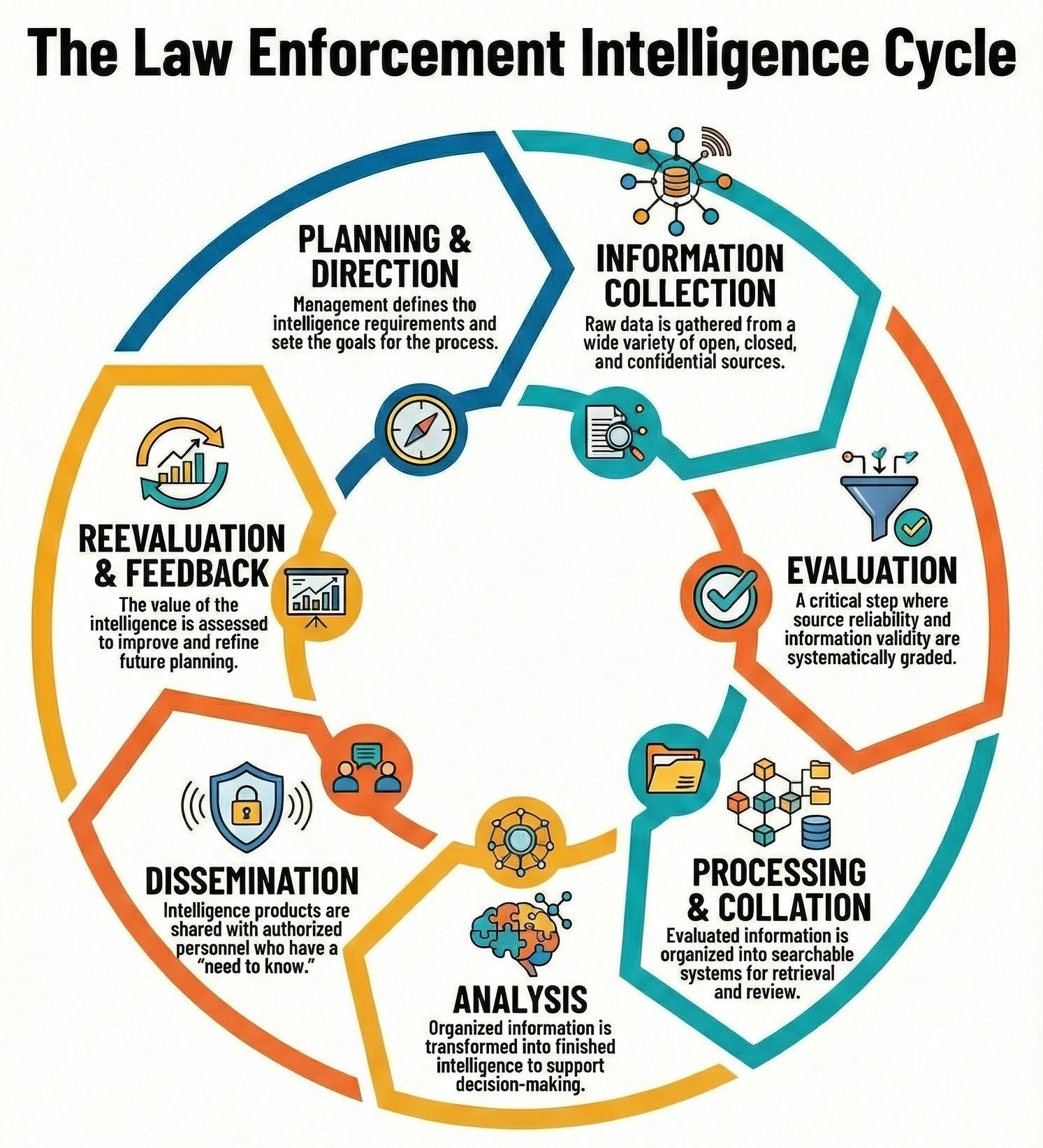
This cycle operates within strict legal and privacy constraints, including limits on information retention and use. Dissemination follows “right to know” and “need to know” principles, and feedback mechanisms support managerial oversight and quality control. The model is designed to scale across agencies of very different sizes while maintaining consistency and accountability.
NATO OSINT Cycle (“4 Ds”)
NATO doctrine presents the OSINT cycle as a simplified four-phase model tailored to the scale and variability of open-source information. It is designed to address discovery, validation, and reduction of large volumes of publicly available data (SACLANT 2002).
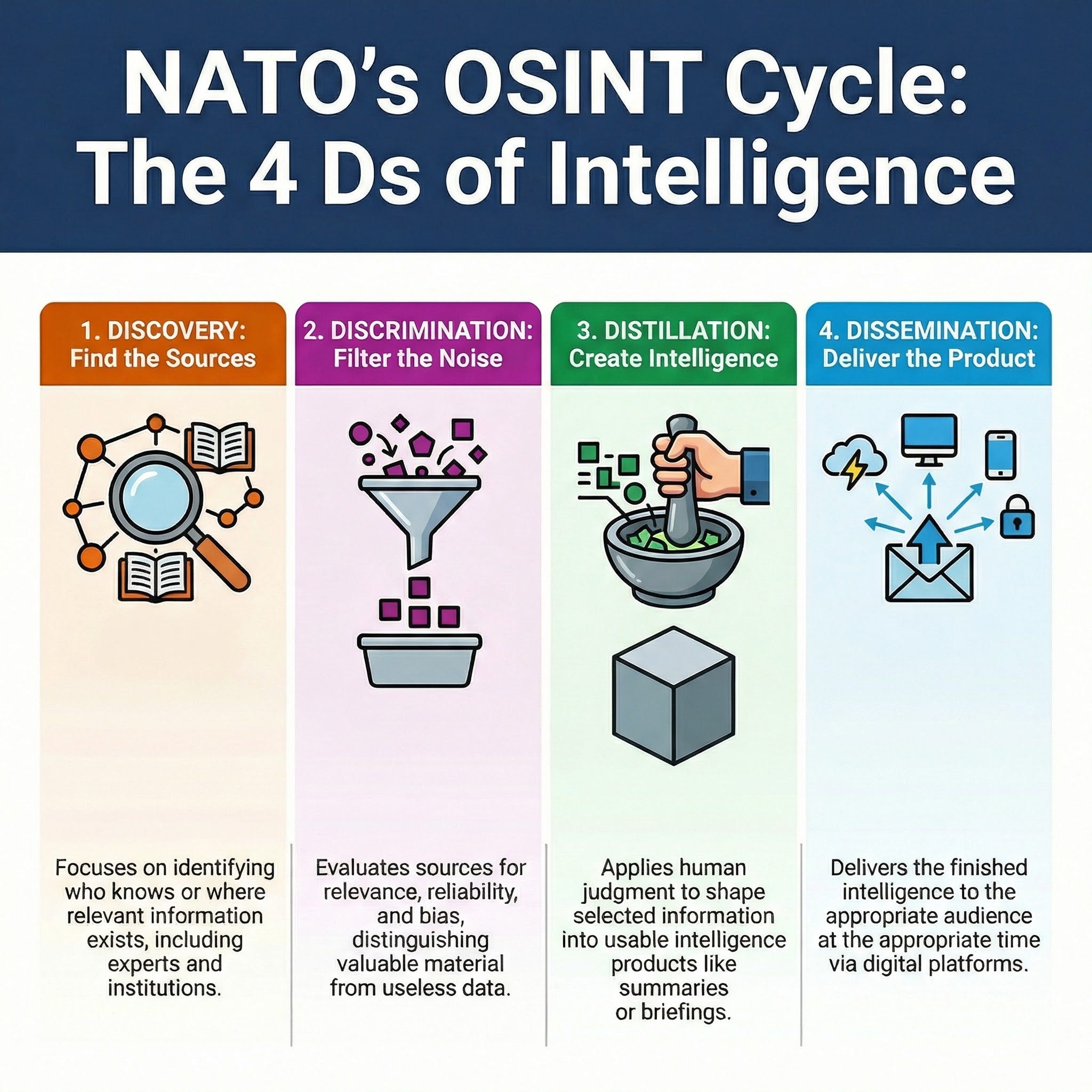
The four phases are:
Discovery - identifying who knows and where relevant information exists
Discrimination - evaluating sources and determining relevance and credibility
Distillation - shaping selected information into usable intelligence
Dissemination - delivering intelligence to the appropriate audience
This model places early emphasis on validation because OSINT sources vary widely in quality and intent. The focus on discrimination and distillation reflects the need to manage noise and prevent volume from overwhelming judgment.
The cycle also reflects NATO’s operating constraints. NATO intelligence staffs lack organic collection assets and rely on OSINT to support coalition awareness and justify requests to member nations. Dissemination emphasizes sharing and accessibility across partners with different clearance levels.
UK National Intelligence Model (NIM)
The UK National Intelligence Model is structured as a business and coordination model for law enforcement, linking intelligence production directly to tasking and organizational control. It standardizes intelligence activity across local, regional, and national levels of policing (Hall 2005).
At a high level, the model includes:
Tasking and Coordination
Intelligence and Information Recording
Research, Development, and Analysis
Intelligence Products
Tactical Resolution
Operational Review
The model defines specific intelligence products, including strategic assessments, tactical assessments, target profiles, and problem profiles. These products drive tasking decisions and operational activity. Operational review feeds results back into the system, reinforcing accountability and learning.
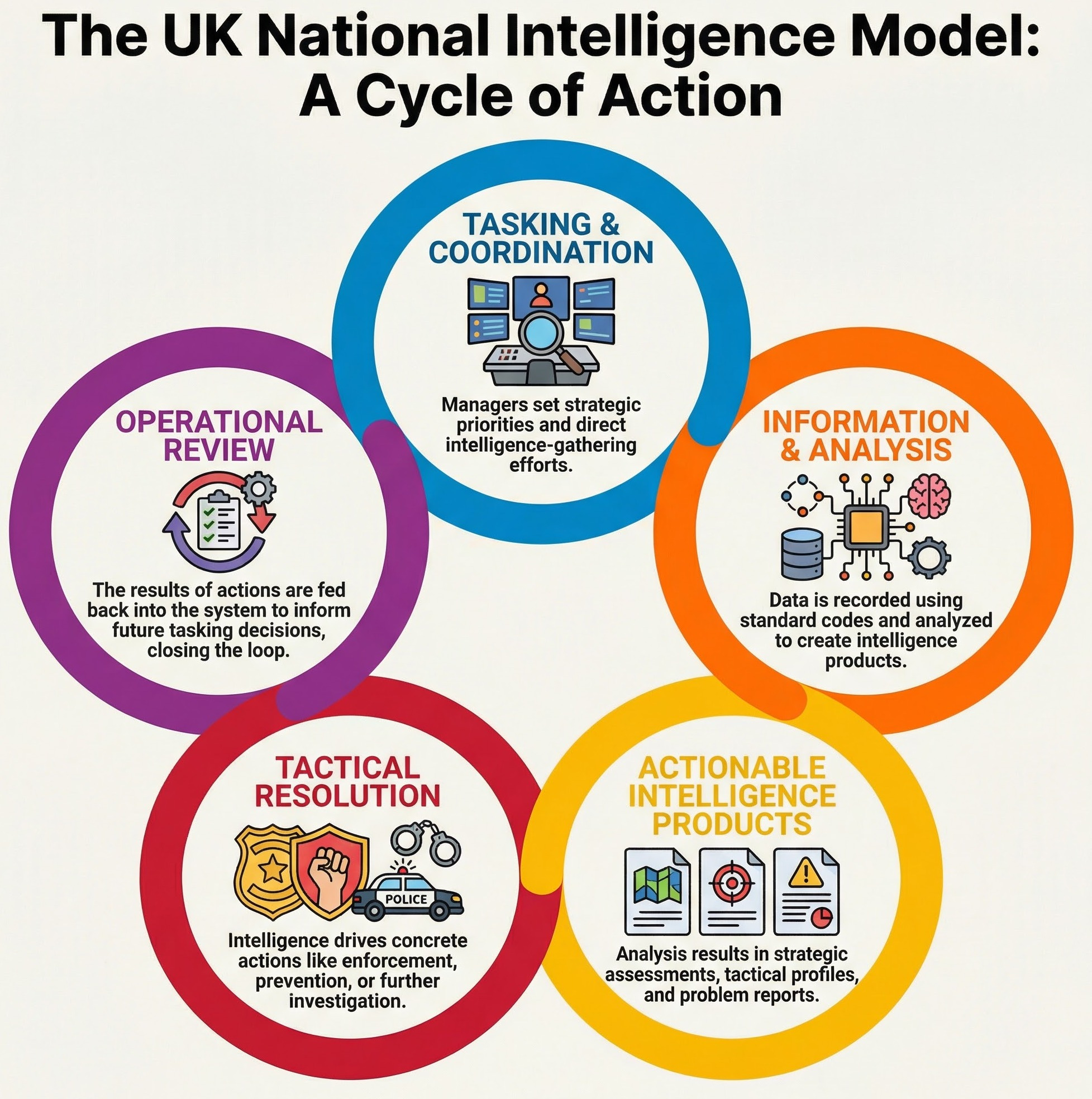
NIM is heavily shaped by legislative and oversight requirements, including proportionality and authorization for covert activity. By framing intelligence as a driver of organizational action, the model embeds intelligence directly into governance and resource allocation decisions.
How To Read These Models
These models don’t contradict each other. They describe the same fundamental intelligence functions using different structures and language, shaped by mission, authority, and operating constraints. The number of steps and the emphasis varies, but the underlying logic remains consistent.
The rest of this series uses a single reference cycle to break those functions down in detail. Later articles will return to these models explicitly and show how each one maps onto the same set of core intelligence activities.
How Intelligence Cycles Operate Across Contexts
The logic of the intelligence cycle remains consistent, while its implementation reflects mission, authority, and operating constraints.
In military and Intelligence Community contexts, the cycle is integrated with command structures and operational planning. Requirements emerge from commander intent, national priorities, or policy objectives. Planning and direction translate those priorities into intelligence requirements, including Priority Intelligence Requirements and associated information needs (AFDP 2-0 2023). Collection often involves multiple intelligence disciplines coordinated through centralized management.
Processing and exploitation convert raw data into usable formats through translation, decryption, and technical processing. Analysis and production integrate all-source information to support judgments about capability, intent, and risk, applying analytic tradecraft to interpret evidence (AFDP 2-0 2023). Dissemination and integration deliver intelligence to commanders and staffs in forms that support decision-making. Evaluation and feedback occur continuously and are judged by how well intelligence supports operational outcomes (JP 2-0 2022; AFDP 2-0 2023).
In law enforcement, the intelligence cycle reflects legal authority, evidentiary standards, and accountability requirements. Planning and direction focus on clearly defined intelligence needs tied to crime patterns, threats, and public safety concerns. Collection includes routine reporting, human sources, surveillance, and open information, all subject to legal and policy constraints.
Processing and collation receive explicit attention because information must be traceable and reviewable. Structured evaluation systems are commonly used to assess source reliability and information validity before analysis begins (OSCE 2017). Analysis supports immediate operational decisions as well as longer-term problem identification. Dissemination connects intelligence to tasking and coordination mechanisms, and reevaluation is embedded in managerial oversight and quality control processes (Global Justice Information Sharing Initiative 2003; Hall 2005).
In civilian, corporate, and non-governmental contexts, the intelligence cycle often appears in a less formalized form. Requirements may be driven by risk management, safety concerns, competitive awareness, or strategic planning. Collection relies heavily on open sources and voluntary reporting. Processing and validation take on added importance due to the volume and variability of available information. Analysis must clearly articulate reasoning and uncertainty because it supports decisions without command authority. Even in simplified form, these cycles follow the same underlying logic of requirement, collection, analysis, dissemination, and feedback (SACLANT 2002; ODNI 2024).
These variations reflect differences in operating environments and authority while preserving the core structure of the cycle.
How The Intelligence Cycle Enforces Analytic Discipline
The intelligence cycle shapes how analytic judgment is applied across an organization. During analysis and production, doctrine requires analysts to integrate, evaluate, analyze, and interpret all-source information to produce intelligence products (AFDP 2-0 2023).
Law enforcement guidance reinforces this expectation by emphasizing that intelligence rests on objective professional judgment, because the quality of underlying data shapes the validity of the resulting product (OSCE 2017). Evaluation occurs before information informs analysis.
Within the Intelligence Community, Analytic Standards require analysts to distinguish information from assumptions and judgments, explain uncertainty, consider alternative perspectives, and describe the quality and credibility of sources, data, and methods (ICD 203 2015). These standards help align analytic confidence with evidentiary strength.
The cycle also governs how timeliness is handled. Joint doctrine permits dissemination of single-source reporting when necessary and requires that its limitations be communicated clearly to consumers (JP 2-0 2022). The cycle keeps uncertainty visible as intelligence moves to decision-makers.
What All Intelligence Cycles Have In Common
Across military, law enforcement, and civilian contexts, intelligence cycles share a consistent set of functions that shape how intelligence work is controlled and corrected over time. Each cycle begins with articulated requirements that guide subsequent activity and give collection and analysis a defined purpose (AFDP 2-0 2023; OSCE 2017). Those requirements provide a reference point for evaluating whether intelligence activity is producing usable insight.
All intelligence cycles incorporate evaluation before information informs judgment. Source reliability, information credibility, and relevance are assessed as part of normal workflow, because analytic confidence depends on the quality of underlying inputs (OSCE 2017). Integration across available sources follows from that evaluation, allowing analysts to develop judgments that reflect the full evidentiary picture rather than isolated reporting (JP 2-0 2022).
Feedback and evaluation function as continuous control mechanisms within every cycle. In military contexts, evaluation is tied to whether intelligence products support commander decision-making and operational outcomes (AFDP 2-0 2023). In law enforcement models, feedback and reevaluation are embedded in managerial oversight to support accountability, legality, and evidence-based decision-making (OSCE 2017). In all cases, feedback identifies gaps, misalignment, and changing priorities, and those signals flow back into planning and direction to shape the next iteration of the cycle.
All intelligence cycles exist to support decisions. Products are developed to inform action, whether those actions involve operations, investigations, or organizational risk management (Smith 1997; JP 2-0 2022). Timely dissemination and feedback ensure intelligence can influence decisions as conditions evolve, keeping judgment aligned with reality instead of static assumptions (ATP 2-22.9 2012; AFDP 2-0 2023).
At their core, intelligence cycles manage uncertainty. They provide a structured way to apply judgment, communicate confidence, surface limits, and adjust when conditions change.
I’m using the Joint & Air Force six-phase intelligence cycle as the reference model for my upcoming articles. That model keeps the full set of intelligence functions visible in one loop and provides a shared language that translates cleanly across military, law enforcement, and OSINT contexts. Other cycle models highlight different constraints and priorities, and I’ll return to those in later articles. For now, this cycle provides a stable reference point for breaking each phase down in detail and examining how decisions made early in the process shape everything that follows.
Closing
Regardless of which model you use, you are using one (hopefully!). Intelligence work doesn’t happen outside a cycle just because the diagram isn’t on the wall. Requirements still get set, information still gets collected and filtered, judgments still get made, and decisions still get influenced. The cycle is already there, shaping outcomes, even when it’s implicit.
The point of laying these models out isn’t to get you to memorize phase names or adopt a preferred diagram. It’s to make the structure visible so you can recognize where your day-to-day work actually sits, what it’s feeding into, and what it depends on upstream. Once you can see the phases as functions instead of boxes, it becomes easier to spot where things are breaking down and where small choices are quietly carrying forward more weight than they should.
As this series goes on, the goal is that you’ll start recognizing these phases in your own work, even when they aren’t labeled that way.
Fantastic deep dive on the topic of intelligence cycles. What are your thoughts or perspectives about the notion that they are outdated or even too rigid in the days of AI?
sounds like the menticide cleaning LLC