The Processing & Exploitation Phase of the Intelligence Cycle
The Intelligence Fundamentals Project

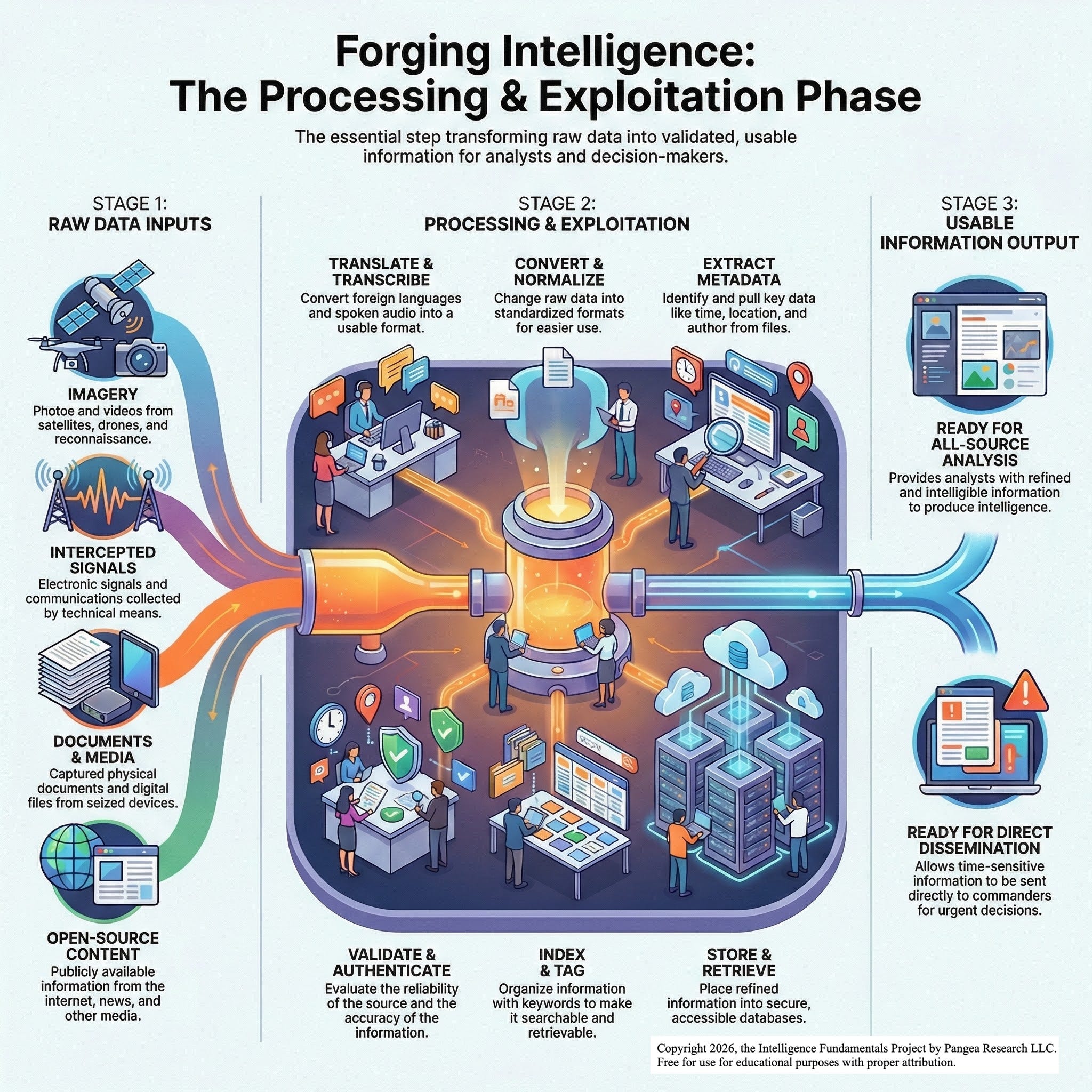
Processing and Exploitation is the phase of the intelligence cycle where collected material is converted into forms that can actually be worked with. It sits between collection and analysis, but its influence extends well beyond that positioning. Decisions made here determine whether raw inputs arrive at analysis as usable information or as disorganized volume that slows everything downstream. Doctrine consistently treats this phase as a core intelligence function, even though it often receives less attention than collection or analysis.
Across military, law enforcement, and Open-Source Intelligence environments, Processing and Exploitation performs the same underlying role despite differences in terminology and organization. It prepares collected material by refining, organizing, validating, and formatting it so it can move forward without imposing unnecessary cognitive or technical burden on analysts and decision-makers. This work is shaped by time constraints, legal authorities, access limitations, and the realities of processing capacity.
How Doctrine Defines Processing and Exploitation
Joint doctrine defines Processing and Exploitation as the conversion of collected information into forms suitable for the production of intelligence. It is described as one of six interrelated categories of intelligence operations, alongside planning and direction, collection, analysis and production, dissemination and integration, and evaluation and feedback. These operations are not treated as a strictly linear sequence. Depending on the intelligence need, they may occur simultaneously, overlap, or be bypassed entirely (JP 2-0 2022).
Joint publications note that some intelligence requests move directly to production using previously collected and exploited material, while in other cases relevant information identified during Processing and Exploitation may be disseminated directly to users without undergoing full all-source analysis (JP 2-0 2022). This framing reflects operational reality. Processing and Exploitation is not limited to preparation for later analysis. In certain circumstances, it produces information with immediate operational relevance.
Air Force doctrine emphasizes that once data is collected, it is processed and exploited in alignment with the commander’s priority intelligence requirements. During this phase, collected data is correlated, converted into suitable formats, and transformed into information that can be disseminated, exploited, stored, retrieved, and used by analysts. Although time-critical interpretation may occur, Processing and Exploitation remains distinct from full all-source analysis and production, and time-sensitive information generated here is expected to move immediately through appropriate intelligence channels rather than being held for later assessment (AFDP 2-0 2023).
Army doctrine frames Processing, Exploitation, and Dissemination as the execution of related functions that convert and refine collected data into usable information, distribute it for further analysis, and, when appropriate, provide combat information directly to commanders and staffs. Collection and processing are described as mutually dependent activities that must be synchronized to deliver critical information at key points throughout an operation (FM 2-0 2023).
Law enforcement intelligence doctrine uses similar concepts under the label of processing and collation. This phase requires an adequate and consistent system for sorting, prioritizing, referencing, and structuring collected information. Information is converted into indexed and cross-referenced formats and transferred into storage systems only after relevance, accuracy, and usefulness have been evaluated. Doctrine also notes that processing and analysis may be closely interlinked in practice, making a clean separation difficult in operational environments (OSCE 2017).
What Processing and Exploitation Is Designed to Do
Raw data has limited utility on its own. Doctrine consistently describes Processing and Exploitation as the point where collected material becomes intelligible and usable. Data collected from sensors, documents, communications, or open sources must be converted into forms that commanders, analysts, and other consumers can understand and act on (JP 2-0 2022).
Different data types require different levels of processing. Some SIGINT processing is increasingly automated and performed directly by collection systems, while captured documents may only require translation before they can be used. In contrast, the technical exploitation of captured equipment may require months of sustained effort before its full capabilities are understood. Processing and Exploitation provides the mechanisms to manage this variability rather than treating all collected material as interchangeable (JP 2-0 2022).
Volume is a persistent challenge, particularly in Internet and open-source environments. Doctrine notes that as much as 99 percent of available data may be noise, consisting of opinion, advertising, or irrelevant material (and I anticipate that volume to increase with the advent of all of the new AI systems we’re seeing, as well as fake accounts botnets, etc). In any case, without disciplined processes of discovery, discrimination, distillation, and dissemination, volume does not translate into intelligence. Processing and Exploitation addresses this problem by distilling material into usable forms through conversion, indexing, annotation, and database construction (NATO OSINT Handbook v1.2 2002).
Doctrine also emphasizes immediacy. Significant unanalyzed operational information and critical intelligence should be available simultaneously to commanders for time-sensitive decisions and to analysts for further assessment. Time-sensitive information identified during Processing and Exploitation is expected to move immediately through intelligence broadcasts, reporting systems, databases, or imagery libraries rather than waiting for full all-source analysis (JP 2-0 2022; AFDP 2-0 2023).
Activities Performed During Processing and Exploitation
Processing and Exploitation encompasses a wide range of technical and procedural activities designed to convert raw inputs into usable information. These activities include imagery exploitation, data conversion and correlation, document and media translation, signal decryption, and reporting results to analysis and production elements (JP 2-0 2022).
An illustrative example appears in ELINT processing. Rather than providing analysts with large volumes of raw signal parameters, Processing and Exploitation associates detected technical characteristics with known systems. This allows analysts to work with essential facts rather than spending time deciphering raw technical data (JP 2-0 2022).
Document and Media Exploitation is a specialized subset of this phase. DOMEX involves the processing, translation, analysis, and dissemination of documents and electronic media under U.S. Government physical control that are not publicly available. This activity excludes collection and initial inventory steps and focuses on converting seized material into usable information (ICD 302 2007).
Law enforcement doctrine places particular emphasis on evaluation during processing. Information is assessed for relevance, reliability, validity, and urgency, with source reliability and information accuracy evaluated separately using formal systems such as the 4x4 or 5x5x5 models. This evaluation occurs simultaneously with or immediately after collection and directly affects how information is stored, handled, and disseminated (OSCE 2017).
Digital processing activities also include hashing and metadata extraction. Hash values demonstrate that digital material has not been altered, while metadata provides information about a file’s creation, modification, access, and collection history. These elements support both analytic credibility and legal defensibility (The TRUE Project 2024).
Boundaries Between Collection, Processing, and Analysis
Doctrine draws clear distinctions between Processing and Exploitation and all-source analysis. Collection, processing, and exploitation are typically performed by specialists within individual intelligence disciplines, while analysis and production are conducted by all-source analysts who integrate information across disciplines (JP 2-0 2022; AFDP 2-0 2023).
Although some interpretation may occur during exploitation, particularly for time-critical reporting, material produced during this phase is not subjected to full all-source analytic assessment. Maintaining this distinction prevents analytic responsibilities from being diluted or prematurely constrained by unprocessed material (JP 2-0 2022; AFDP 2-0 2023).
At the same time, doctrine stresses that collection and processing are mutually dependent. Intelligence staffs are expected to monitor processing outcomes alongside collection results to assess overall effectiveness and prevent seams from emerging between functions, even when those functions are geographically separated (FM 2-0 2023).
Army doctrine also distinguishes between single-source exploitation and all-source analysis. Single-source collectors perform initial exploitation by adding context based on their expertise before reporting to analytic elements, while all-source analysts conduct broader assessment to identify trends, patterns, and opportunities (FM 2-0 2023).
Differences Across Operating Environments
In military intelligence environments, Processing and Exploitation may be conducted by the collecting unit, federated across multiple nodes, or distributed through centralized exploitation centers. Federated exploitation planning is typically conducted during joint planning to ensure appropriate routing of raw data and sufficient analytic throughput. Expeditionary PED capabilities are emphasized to maintain functionality in austere or degraded environments (JP 2-0 2022; FM 2-0 2023).
Law enforcement intelligence environments emphasize consistent systems for processing and collation. Information is sorted, prioritized, structured, evaluated, assigned handling codes, and stored in retrievable formats. These steps are considered essential for analytic accuracy and appropriate dissemination (OSCE 2017).
OSINT environments rely heavily on human judgment during Processing and Exploitation. Doctrine notes that open sources require the same discrimination as clandestine sources and that translation, evaluation, and archiving are often manual processes. Without dedicated automation tools, OSINT processing depends on sustained human effort, and effective exploitation may require archiving content rather than relying on bookmarks or live access (NATO OSINT Handbook v1.2 2002).
Quality, Credibility, and Traceability Requirements
Processing and Exploitation directly supports analytic quality and transparency. Analytic standards require products to identify underlying sources and methodologies and describe factors affecting source quality, credibility, and currency. These requirements depend on proper processing, evaluation, and documentation of material before analysis begins (ICD 203 2015; ICD 206 2015).
Law enforcement doctrine similarly requires formal evaluation systems to support accuracy, dissemination decisions, and compliance with data protection standards. Evaluation demonstrates that information recording is justified, necessary, and proportionate (OSCE 2017).
Doctrine also requires source preservation. Records of dynamic or ephemeral sources must be retained to support transparency, credibility, and retrievability, enabling readers to assess the scope and quality of sources underlying analytic judgments (ICD 206 2015).
Consequences of Weak Processing and Exploitation
Doctrine is explicit about the risks of weak Processing and Exploitation. High signal-to-noise ratios in open-source environments mean that volume alone does not produce intelligence without disciplined processing (NATO OSINT Handbook v1.2 2002). Ineffective processing can also result in circular reporting, where information is repeatedly retransmitted through multiple channels without added value (AFDP 2-0 2023).
In law enforcement contexts, poor data quality can lead to inappropriate or ineffective tactics and may undermine legal integrity if information is not processed in accordance with data protection principles (National Centre for Policing Excellence/ACPO 2005).
Closing
Across doctrine, Processing and Exploitation is treated as a disciplined phase that shapes whether collected material can actually support intelligence work. Military, law enforcement, and Open-Source Intelligence models consistently describe this phase as the point where raw inputs are converted, evaluated, and structured so they can move forward without distorting or delaying analysis.
Decisions made during Processing and Exploitation affect more than technical readiness. How information is formatted, validated, preserved, and disseminated influences analytic confidence, sourcing transparency, and the ability to explain judgments to decision-makers. Weak processing introduces noise, obscures provenance, and increases the likelihood that analysts spend time repairing data rather than assessing meaning.
Understanding this phase as part of routine intelligence practice helps practitioners see where responsibility lies and why it matters. Processing and Exploitation is not a substitute for analysis, and it is not a mechanical step that can be treated as incidental. Its effectiveness depends on deliberate management, trained personnel, and integration with collection and production functions, all of which shape what intelligence can realistically deliver.